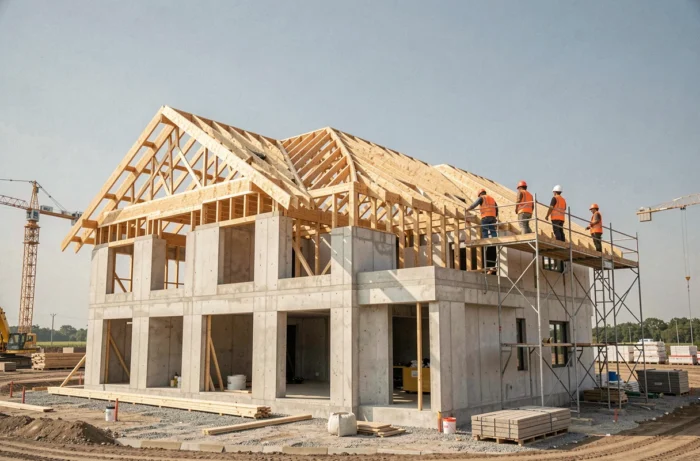
The waterproofing phase in VEFA triggers a call for funds that represents a significant portion of the total price of the property. Understanding what this step entails, its legal implications, and what to verify before making a payment can help avoid disputes that have been increasing since the recent tightening of case law.
VEFA Calls for Funds: Regulatory Caps and Recent Case Law
The payment schedule for a VEFA purchase follows a timeline governed by the Construction and Housing Code. Each call for funds corresponds to a specific stage of the construction progress.
| Construction Stage | Cumulative Payment Cap |
|---|---|
| Completion of Foundations | 35% of the price |
| Waterproofing | 70% of the price |
| Completion of the Building | 95% of the price |
| Delivery (handover of keys) | 100% of the price |
The jump from 35% to 70% between the foundations and the waterproofing represents the highest leap in the entire schedule. It is at this stage that the buyer commits the largest portion of financing in one go.
Since 2023, the Court of Cassation has reminded that these calls for funds can only be required in exact correlation with the actual state of progress of the construction (Cass. 3e civ., May 25, 2023, n° 21-23.488). Therefore, the developer cannot demand 70% if the roof is not actually installed. Each portion of the price is subject to a statute of limitations starting from the due date specified in the contract, independently of the other portions.
To delve into the technical aspects related to this phase, the section dedicated to waterproofing VEFA on Immo Factory details the relevant works and their monitoring.
Waterproofing and Airtightness: Two Distinct Technical Milestones
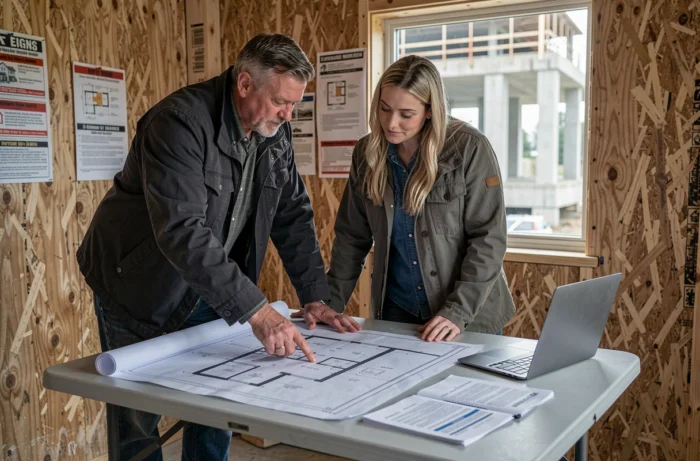
The confusion between waterproofing and airtightness is common. These two stages follow one another, but they do not protect the building against the same types of aggression.
Waterproofing refers to the moment when the roof is installed and the building is protected from infiltrations from above: framework, covering (tiles, slates, metal trays depending on the project), waterproofing elements. The building remains open on the sides.
Airtightness occurs afterward. It corresponds to the installation of exterior joinery (windows, doors, sliding glass doors) that closes the building against lateral weather and wind. At this stage, the building envelope is complete.
- Waterproofing protects against vertical rain: framework, covering, zinc work (gutters, valleys, flashings)
- Airtightness closes the building: exterior joinery, glazing, peripheral sealing joints
- Finishing work (interior insulation, plumbing, electricity, partitions) only begins once these two stages are validated
However, only waterproofing triggers the call for funds at 70%. Airtightness does not have a specific payment milestone in the regulatory schedule, even if some contracts provide for an intermediate call.
Checks to Perform Before Paying the 70% Call for Funds
The tightening of case law gives the buyer a concrete lever: to verify that the construction site actually corresponds to the announced stage before paying. A developer who sends a premature call for funds exposes themselves to a legitimate refusal from the buyer.
Points to examine during a site visit at the waterproofing stage:
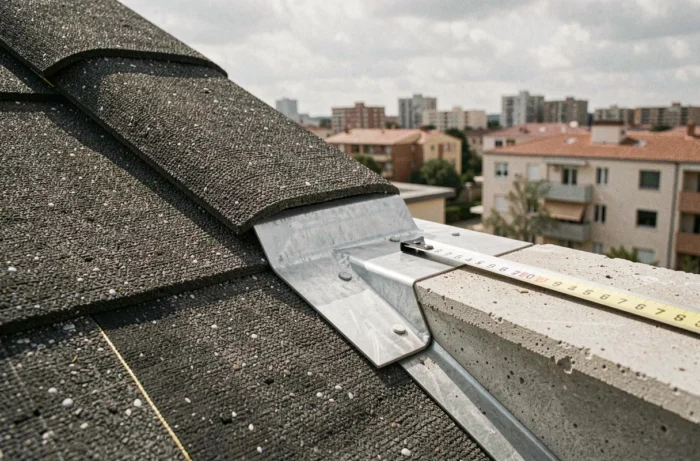
- The roof is fully installed, including edges, ridges, and zinc work (no temporary tarps on uncovered areas)
- The load-bearing walls and structure are completed up to the level specified in the plans
- The rainwater downpipes are in place or at least the connections are visible
- No area of the upper slab is exposed to the elements without permanent protection
If tarps still cover part of the roof or if any framework elements are missing, the waterproofing is technically not completed. The call for funds at 70% is therefore not exigible.
RE2020 and Airtightness Test: A Post-Airtightness Constraint to Anticipate
The environmental regulation RE2020 has introduced a requirement that directly impacts the phase following airtightness. For new houses, an airtightness test is mandatory. This test measures the air leakage rate through the building envelope and conditions the issuance of the compliance certificate.
In practice, this test can only be carried out once airtightness is complete: all joinery installed, all joints made. A defect detected at this stage (poorly installed joinery joint, unsealed duct passage) requires corrections before proceeding with the finishing work.
For the buyer in VEFA, this constraint means that a delay in achieving airtightness mechanically affects the overall schedule. The airtightness test becomes an additional control point to monitor in the construction reports provided by the developer.
Completion and Delivery VEFA: Waterproofing Alone is Not Enough
A decision from the Court of Cassation on February 13, 2025 (n° 23-17.755) specifies that a building sold in VEFA cannot be considered completed until certain technical certificates are provided to the buyer, notably the Consuel (electrical compliance) and Qualigaz (gas compliance). Therefore, waterproofing and airtightness, even if perfectly executed, do not constitute legal completion.
This distinction has direct consequences on delay penalties. A developer who would invoke the completion of the structural work to free themselves from their deadline obligations now faces unfavorable case law. The buyer retains their right to penalties as long as all technical certificates have not been produced.
Waterproofing remains the heaviest financial milestone of the VEFA, but it does not mark the end of technical risks or the developer’s obligations. Monitoring the actual progress of the construction at each call for funds, keeping the visit reports, and demanding regulatory certificates upon delivery are the three reflexes that effectively protect the buyer throughout the operation.