Since September 1, 2026, a financial penalty has been imposed on ultra-fast fashion clothing sold in France. This measure, combined with new display obligations on e-commerce platforms, is reshaping how fashion and beauty advice for women can be formulated. What objective criteria today allow us to distinguish a thoughtful purchase from a penalized one, and how do these regulatory constraints concretely modify clothing recommendations and beauty routines?
Anti-fast fashion penalty: what women’s fashion advice must integrate
Most women’s fashion guides continue to recommend trendy pieces without mentioning the regulatory framework that now applies to online purchases. The penalty published in the Official Journal at the end of August 2026 specifically targets ultra-fast fashion items, with penalties reaching up to 19.50 euros per garment according to the terms revealed by the government.
This surcharge is not trivial. It transforms the price-quality ratio of certain cheap pieces, sometimes making a discounted basic more expensive than a mid-range garment made in Europe. The table below summarizes the main differences between a purchase subject to the penalty and a purchase not affected.
| Criterion | Item subject to penalty | Item not subject to penalty |
|---|---|---|
| Maximum penalty per piece | Up to 19.50 euros | None |
| Display of manufacturing location | Mandatory, legible at the price level | Mandatory (general e-commerce rule) |
| Collection renewal | Ultra-fast (several hundred references per week) | Seasonal or reasoned |
| Impact on final price | Significant increase in displayed price | Stable |
For any woman building her wardrobe online, checking if a platform is subject to this penalty becomes a reflex as useful as comparing sizes or reading reviews. Platforms that publish very large volumes of new references each week are the primary targets.
Editorial spaces like Histoires de Filles approach fashion and beauty from a personal angle, mixing confessions and concrete recommendations, which allows filtering trends through the lens of daily life rather than just marketing.

Mandatory display of manufacturing location: a filter for choosing clothes
The regulatory framework now requires e-commerce platforms to better display the manufacturing location, clearly and legibly at the price level. This requirement changes the game for online clothing purchases.
In practice, a dress spotted on a marketplace now shows its country of manufacture next to its price. This transparency allows for the quick cross-referencing of two pieces of information: the price and the geographical origin.
What this requirement changes for a women’s wardrobe
Before this rule, recommending a pair of pants or a professional outfit often meant comparing cuts and colors. The manufacturing location remained buried in a technical sheet rarely consulted. Now, style advice benefits from integrating this parameter as a selection criterion alongside cut or color.
- A garment made in a country subject to strict social and environmental standards generally has superior durability, justifying a higher investment in frequently worn pieces.
- Items from ultra-fast fashion, identifiable by their origin and production volume, lose attractiveness as soon as the penalty is added to the base price.
- For everyday looks as well as professional attire, prioritizing basics with clearly displayed origins reduces the risk of buying a garment that distorts after a few washes.
The mandatory display of the manufacturing location becomes a more reliable sorting tool than marketing labels (“eco-responsible,” “conscious collection”) whose criteria vary from one brand to another.
Lazy girl beauty trend: when the beauty routine simplifies in fall 2026
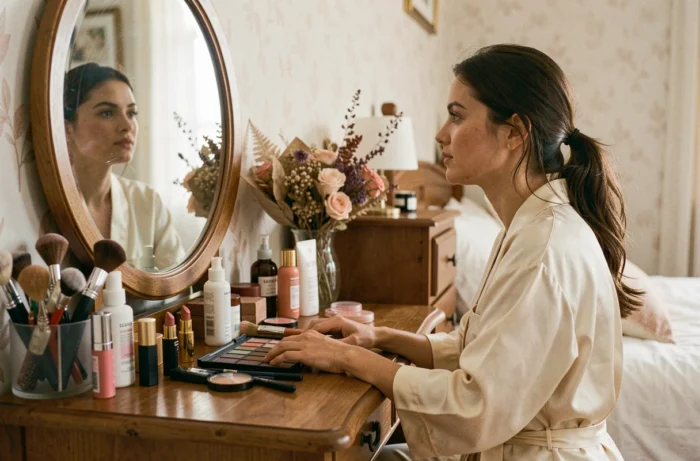
On the beauty side, fall 2026 confirms an aesthetic direction that breaks away from twelve-step routines. The lazy girl beauty values quick and minimalist routines, with makeup focusing on natural skin rather than layering products.
This trend is not just about morning laziness. It aligns with a logic of reducing the number of products purchased, which indirectly connects to the anti-overconsumption concerns raised by the anti-fast fashion law.
Lazy girl beauty versus classic routines
Women’s magazines and beauty blogs have long structured their advice around complete routines: cleanser, toner, serum, cream, primer, foundation, concealer, powder, blush, mascara. Lazy girl beauty proposes the opposite: fewer products, better chosen, applied in a few minutes.
In practice, this means a tinted moisturizer that replaces foundation and day cream, a colored lip balm that doubles as blush, and mascara. The time savings are real, but the financial savings are too: reducing one’s routine to four or five products instead of ten mechanically lowers the monthly beauty budget.
This minimalist approach also changes how influencers recommend products. Partnerships with brands offering extensive ranges lose relevance when the audience seeks simplicity. Content creators who adopt lazy girl beauty tend to recommend fewer references but with more detailed reviews on each product.

Fashion-beauty influencers and transparency constraints: what changes in recommendations
The new rules do not only concern sales platforms. Content creators who recommend clothing or cosmetics must navigate a more regulated environment. The penalty on ultra-fast fashion makes certain partnerships less attractive for influencers whose audience seeks good value for money.
A clothing recommendation pointing to a platform subject to the penalty exposes the influencer to a discrepancy between the price displayed in their video and the final price paid by the subscriber. This dissonance undermines trust, a capital that is difficult to rebuild.
For readers seeking reliable fashion and beauty advice, a simple indicator emerges: the creator’s transparency regarding the origin of the recommended pieces and the potential existence of the penalty. Content that mentions these elements provides more comprehensive information than those limited to a promo code.
The landscape of women’s advice, whether choosing a dress for an event or putting together a professional look, now incorporates concrete regulatory parameters. The penalty applicable since September 2026 and the mandatory display of the manufacturing location are not topics reserved for lawyers: they are decision filters that directly impact the price and quality of what ends up in a wardrobe.