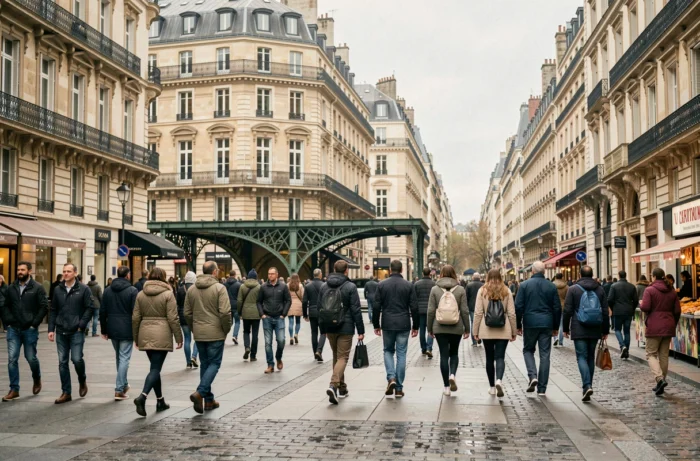
The Châtelet district comes up in almost every conversation about safety in Paris. Tourists, students looking for shared housing, workers who transit through the underground station every day: everyone has an opinion, often strong. But does this reputation rest on measurable facts or on an accumulation of individual stories amplified by the massive foot traffic in the area?
Massive Foot Traffic and Risk Perception at Châtelet-Les Halles
Châtelet-Les Halles is the main public transport hub of the capital. Several metro and RER lines intersect there, making it one of the busiest stations in Europe. This volume of daily traffic radically changes the perception of danger.
When an incident occurs in a place traversed by hundreds of thousands of people, it is seen, filmed, and reported. The same type of incident in a less frequented station goes unnoticed. Foot traffic makes incidents more visible, not necessarily more frequent.
An article dedicated to the safety of the district points out that the available data does not establish a particular degradation compared to other major Parisian stations. To better understand the Châtelet district in Paris, one must accept that the nuance between feeling and statistics is rarely made in the media.
Crime Statistics in the Paris Metro: What They Really Say
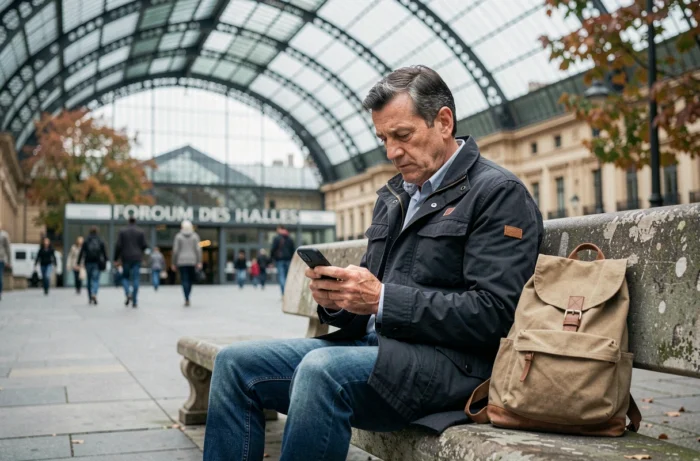
Have you ever looked for precise figures on crime at Châtelet? You probably found data on the entire Île-de-France network, not on a specific station.
This is the central point of the debate. The SSMSI (statistical service of the Ministry of the Interior) publishes data on thefts and violence in public transport in Île-de-France. These figures confirm that the metro accounts for a significant share of the incidents recorded in transport. But they are not broken down by station.
In other words, nothing in the official statistics allows us to assert that Châtelet is riskier than Gare du Nord, République, or Nation. The ranking of “the most dangerous stations” found on some websites is not based on any official data published at this scale.
The Issue of Unreported Crimes
The SSMSI notes another important bias. Victims of non-violent thefts in transport are less likely to file a complaint than victims of other types of theft. A pickpocket who steals a phone in a crowd rarely leads to a complaint being filed.
The consequence is twofold: official figures likely underestimate the actual number of thefts, and this underestimation varies from place to place depending on the nature of the incidents. Comparing two stations based on this incomplete data makes no statistical sense.
Nocturnal Safety Around Châtelet: The Real Parameters
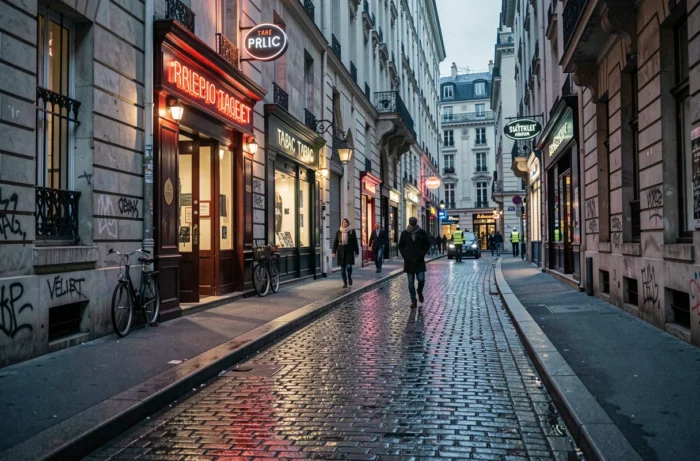
The district’s reputation crystallizes mainly around late hours. Several testimonies converge on one observation: the atmosphere changes significantly after a certain hour, particularly in the underground corridors and around the Nelson-Mandela garden.
This phenomenon is not unique to Châtelet. The major underground stations in Paris all experience a change in atmosphere in the evening, when foot traffic decreases and surveillance measures are reduced. The difference with Châtelet lies in the size of the underground network, which is particularly extensive and includes many connecting corridors.
What Changes at Night
- The connecting corridors empty out after the last RER trains, reducing the presence of witnesses and creating isolated areas despite the central location
- The areas around the Canopée and the underground forum attract stationary groups, which can generate a feeling of insecurity even without direct aggression
- Police presence varies according to periods and occasional measures, with no guarantee of permanent patrols throughout the entire perimeter
These elements explain why the nighttime perception is negative without it necessarily translating into a higher crime rate than in other central neighborhoods.
Concrete Precautions Based on the Context of Passage
Rather than classifying Châtelet as “dangerous” or “safe,” it is more useful to reason by situation. The risk depends less on the district itself than on the time, the route, and the behavior adopted.
During the day, the Châtelet district does not present any particular risk compared to the rest of central Paris. The density of passersby, open shops, and surveillance cameras makes assaults rare on the surface. The main risk remains pickpocketing in areas of high foot traffic, as in any tourist spot in Paris.
Adapting Your Route in the Evening
In the evening, a few simple reflexes reduce exposure to risk:
- Prefer surface metro exits rather than long underground connecting corridors, especially after the end of RER service
- Avoid remaining stationary in the less frequented areas of the underground forum
- Keep your phone and valuables in a closed inner pocket, especially in escalators and on platforms
- If possible, take the shopping streets on the surface (rue de Rivoli, rue des Halles) rather than crossing the underground complex
These precautions apply to all major Parisian stations, not just Châtelet. The specificity of the location lies in the extent of the underground network, which multiplies the poorly monitored transition areas.
The reputation of Châtelet rests on a mix of real facts (pickpockets, degraded nighttime atmosphere) and a magnifying effect related to its foot traffic. Official data do not confirm a level of danger higher than that of other major stations in central Paris. The district above ground remains lively, commercial, and frequented. The risk concentrates in the underground spaces during off-peak hours, a parameter that everyone can manage by adapting their route.