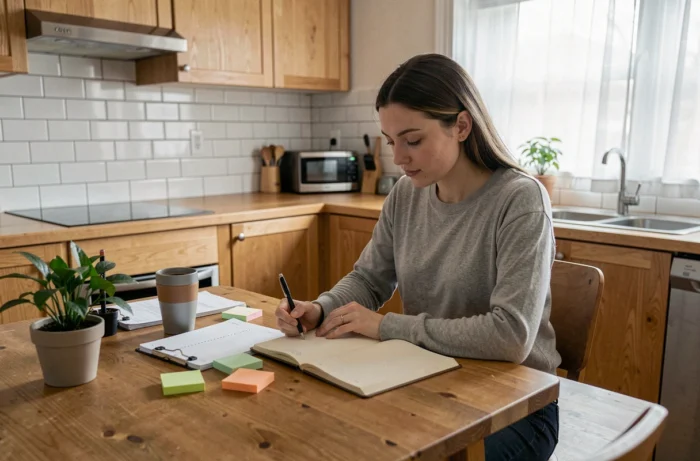
Becoming self-sufficient in daily life relies on measurable skills: managing a budget, preparing meals, maintaining a home, and the ability to seek out the right resources. The five steps below each target a concrete lever, classified not by priority but by area of action. Each step is assessable: either you master it, or it becomes your next goal.
1. Build a personal budget with weekly tracking

The first skill of financial independence is not earning more, but knowing where every euro goes. Weekly tracking (rather than monthly) allows you to spot discrepancies before they accumulate.
Understanding how to become self-sufficient in daily life starts with this budgeting discipline, as it conditions all other steps.
| Tracking Frequency | Detection of Deviations | Possible Adjustment |
|---|---|---|
| Daily | Immediate | Reallocation the next day |
| Weekly | Within 7 days | Correction during the month |
| Monthly | Late | Postponed to the following month only |
Weekly tracking represents the best compromise between effort and responsiveness. Three categories are sufficient at the start: fixed expenses, food, and remaining funds. Any additional category can come after the first month of practice.
2. Master a foundation of five complete recipes

Cooking for oneself appears in all self-sufficiency guides, but the advice often remains vague. The measurable approach is to aim for five balanced recipes that can be replicated in under thirty minutes each.
These five recipes ideally cover different bases: a soup, a legume-based dish, a starch-based preparation, an egg-based meal, and a seasonal adaptable dish. With this foundation, dependence on prepared meals or restaurants decreases mechanically.
- Each recipe should use ingredients available year-round to avoid seasonal habit disruptions.
- Preparation time should not exceed the duration of a meal delivery; otherwise, the ordering reflex takes over.
- The corresponding shopping list should fit on a maximum of ten lines to remain manageable without an app.
The goal is not to become a chef but to eliminate food dependence on external services for daily meals.
3. Establish a cleaning routine for the home by zones
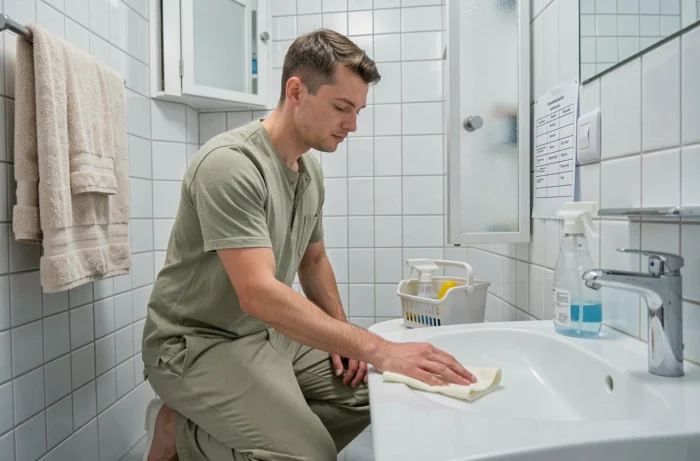
A deteriorating home generates stress, restoration costs, and sometimes conflicts in shared living situations. Cleaning by zones involves assigning a fixed and short time slot (a few minutes) to each area of the home on a weekly cycle.
On Monday, the kitchen. On Wednesday, the bathroom. On Friday, the common areas. This division avoids the “big clean” syndrome that gets indefinitely postponed. With simple cleaning products (white vinegar, black soap, baking soda), the cost remains minimal.
In shared living situations, this method has an additional advantage: it makes responsibilities visible and shareable. A displayed schedule with zones and names avoids most tensions related to cleaning.
4. Identify and seek available support resources
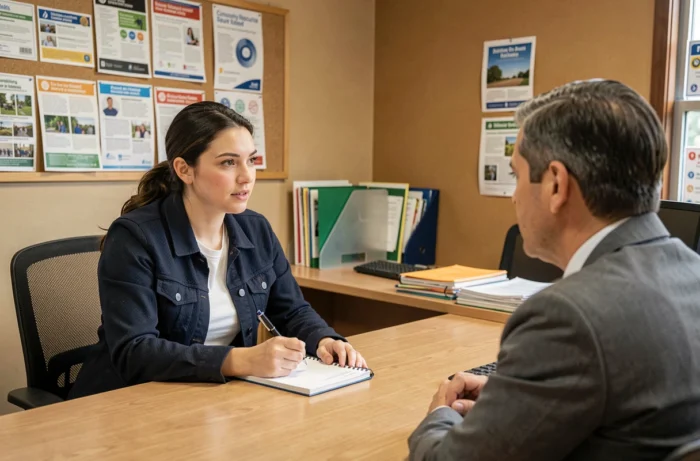
Independence does not mean doing everything alone. It includes the ability to identify existing support systems and use them at the right time. Since the reform of the Validation of Acquired Experience (VAE), the public digital platform France VAE simplifies access to certifications for home support professions. Validation block by block is now possible, without the prior requirement of a year of continuous experience.
This evolution has a direct impact on anyone seeking independence: professionals working in home care (home helpers, educational and social support workers) have precise reference frameworks covering daily life activities, from mobility to meal preparation.
Knowing that qualified support exists, understanding the access conditions, and daring to seek it out is an integral part of independence. A truly independent person knows how to distinguish what they can do alone from what requires support.
5. Secure daily life with a practical skills kit
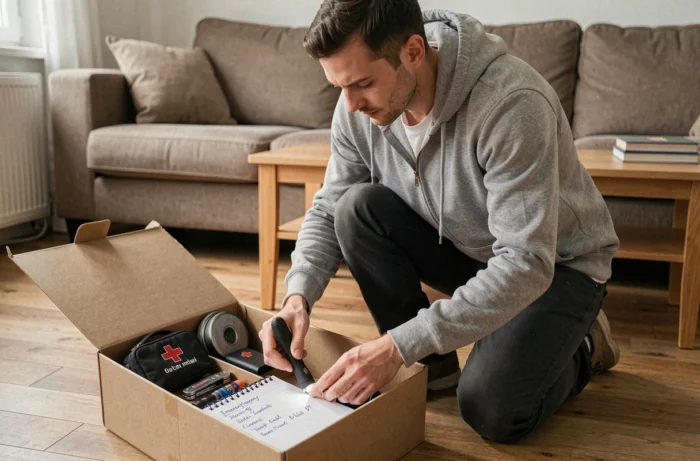
Beyond food and cleaning, several micro-skills condition safety and quality of life in daily life. This kit brings together know-how that is rarely taught together.
- Knowing how to turn off water, gas, and electricity in one’s home (locating valves and the circuit breaker upon moving in).
- Re-sewing a button or patching a tear to extend the lifespan of clothing and limit textile expenses.
- Reading and understanding a lease or home insurance contract, including cancellation clauses.
- Managing first aid (disinfection, bandaging, assessing severity) before deciding whether to consult.
Each of these skills can be learned in a single session. The total time for acquisition is just a few hours, for a gain in independence that lasts for years.
Daily independence is not a binary state. It is a combination of financial, food, domestic, and relational skills that mutually reinforce each other. A well-managed budget alleviates stress, homemade meals reduce expenses, regular maintenance preserves the home, and the ability to ask for help prevents isolation. Each step achieved makes the next one more accessible.