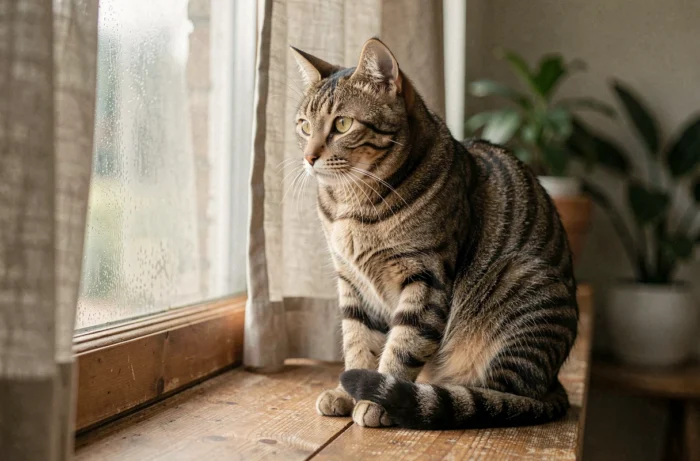
A cat that starts urinating outside its litter box or stops grooming itself sends a clear signal. Before attributing this to a whim or a bad habit, it’s wise to observe the context: a change of furniture, a new roommate, a poorly placed litter box. A cat’s daily behavior directly reflects its level of comfort, and most effective adjustments cost nothing, provided you know where to look.
Silent Pain in Cats: Signals Masked by Routine
It’s easy to spot a limping dog. In cats, pain manifests in much more subtle ways. A feline suffering from arthritis, for example, does not whine: it jumps less, hesitates at the windowsill, or sleeps in unusual positions.
Veterinarian Victor Algra emphasizes: unlike dogs, cats can feel pain without us realizing it. This discretion stems from their status as solitary predators. Showing weakness in the wild is exposing oneself. This reflex persists even in an apartment.
Several behaviors warrant immediate attention:
- Excessive grooming or, conversely, a coat that becomes dull and neglected, a frequent sign of chronic pain or prolonged stress.
- A cat that hides unusually, especially during the day, when it previously sought contact.
- A gradual decrease in appetite without a change in food, often wrongly attributed to heat or age.
A recent veterinary monitoring tool proposes to transform these daily observations (activity, appetite, social interactions, grooming) into a structured quality of life score. This type of grid helps to objectively decide whether to consult, adjust the environment, or consider pain management. In-depth resources can be found on cats on Syntonie Animale to better analyze these signals over time.
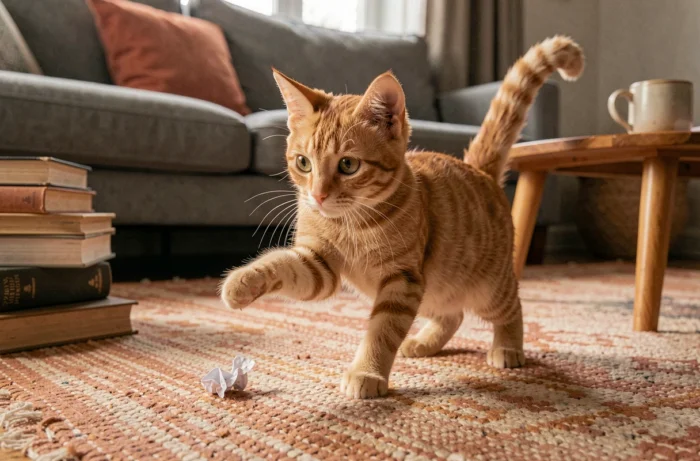
Food Enrichment: Reducing Stress for Indoor Cats
A cat that constantly begs, meows at the door, or scratches furniture is not necessarily hungry. In many cases, it is food boredom that triggers these behaviors.
The feline is programmed to hunt small prey several times a day. In an apartment, a full bowl eliminates the entire sequence: spotting, stalking, catching. This behavioral void produces stress, and the cat compensates as best it can.
Food Puzzles and Simulated Hunting Games
Food puzzles (ball dispensers, digging mats, perforated tubes) force the cat to work for access to its food. A recent study on indoor cats shows that enrichment at mealtime reduces excessive solicitation behaviors in less than a month.
Specifically, you can start with a simple cardboard tube with folded ends and holes. The cat pushes it, and kibble falls out. There’s no need for expensive equipment at the start.
Responses vary on this point: some cats adopt the puzzle within a few days, while others take two weeks to understand the mechanism. Leaving the device next to the regular bowl during the adaptation period avoids frustration.
Vertical Space and Hiding Spots: What Cats Expect from Their Environment
We often think in terms of floor space when evaluating the available area for a cat. The feline, however, thinks in volume. A studio with three levels of access is more suitable for it than a large living room without shelves or perches.
High Structures and Observation Posts
Available data confirms that with high structures, observation posts, and hiding spots, cats show fewer signs of stress after a few weeks of responsible confinement. This result applies even to former outdoor cats transitioning to indoor life.
A well-placed cat tree in front of a window serves two functions: an observation post (visual stimulation) and a high refuge (sense of security). The position is as important as the object. A cat tree relegated to a dark hallway will not be used.
Accessible Hiding Spots at All Times
A cat needs to retreat without negotiation. An open box under a piece of furniture, a partially emptied shelf, or a fabric tunnel is sufficient. A common mistake is to remove the hiding spot when the cat seeks refuge “too often.” The opposite should be done: a cat that hides needs its hiding spot to remain available to regain its security at its own pace.
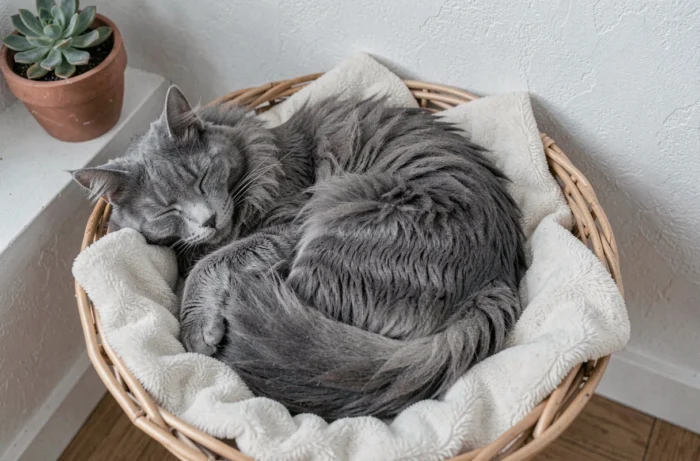
Cat Litter: Placement and Maintenance, Common Mistakes
Litter boxes concentrate a disproportionate share of feline behavioral problems. A poorly placed or poorly maintained box leads to uncleanliness, urine marking, and chronic stress.
Three practical rules make a difference:
- One box per cat, plus one extra. In a household with two cats, aim for three litter boxes spread across different rooms.
- No litter box next to the food bowl. The cat strictly separates its elimination and feeding areas. Even two meters apart in the same room can pose a problem.
- Daily cleaning of clumps, with a complete substrate change once or twice a week depending on the type of litter used.
A closed box (litter house) appeals to humans but not always to the cat. Odors concentrate inside, and the feline loses visibility of its environment during a moment of vulnerability. If the cat scratches the walls of the closed box or hesitates to enter, removing the lid often resolves the issue.
A sudden change of substrate (switching from mineral litter to plant-based litter, for example) can also trigger a refusal. The transition should be made by gradually mixing the two types over about ten days.
A cat’s daily behavior can be read in these concrete details: the height of the jump it avoids, the bowl it neglects, the box it circumvents. Every micro-adjustment in the environment produces a measurable effect on its well-being. Observe first, intervene later, and always allow the feline time to adapt.