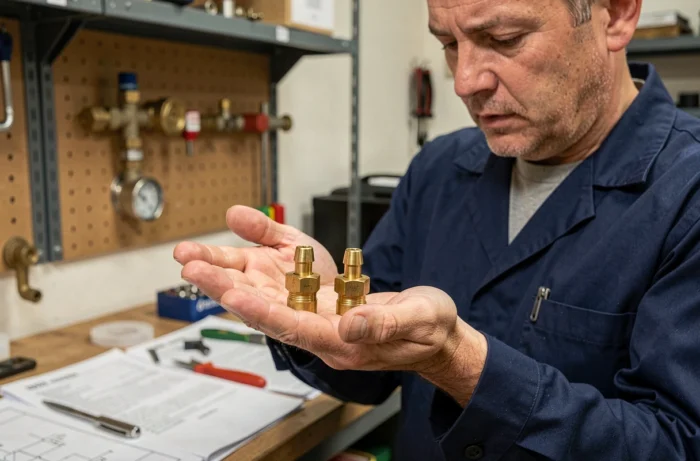
When you acquire a second-hand cooker or move into a home supplied differently from the previous one, the first concrete question that arises concerns the injectors. G20, G30: these two codes determine whether the appliance is compatible with the gas available at your location. Choosing the wrong category risks an unstable flame, overconsumption, or even carbon monoxide release.
Diameter of G20 and G30 injectors: why size matters
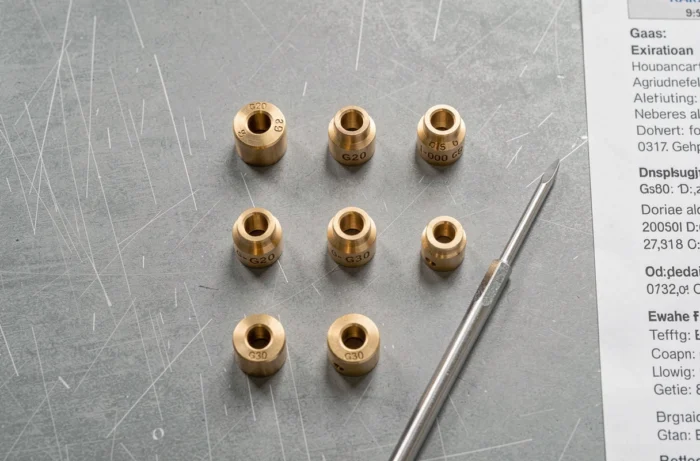
An injector is a small brass piece with a calibrated orifice. The diameter of this orifice controls the gas flow to the burner. The entire G20/G30 logic hinges on this.
Natural gas (G20) has a lower distribution pressure than butane or propane in bottles. To achieve the correct power, the G20 injector has a wider orifice than its G30 counterpart. Conversely, butane and propane (G30/G31) arrive under higher pressure: the orifice must be narrower to prevent excess gas in the burner.
Specifically, on a standard cooker, a rapid burner supplied with natural gas uses an injector with a reference that can reach 1.29 millimeters, while the same burner using butane/propane drops to around 0.87 millimeters. These values vary by manufacturer and the nominal power of the burner, hence the need to consult your appliance’s manual.
This same logic applies to the auxiliary burner (the small flame) and the oven burner. Each position has its own size. An article detailing the differences between G20 and G30 gas injectors according to the types of burners allows you to verify the exact match for your model.
Natural gas to bottle conversion: common on-site mistakes
The classic scenario: moving from an apartment connected to city gas to a house without a network, supplied by a butane or propane bottle. The cooker works, but the injectors need to be replaced.
Mixing injectors between burners
Each burner has a specific diameter injector. If you swap the injector from the auxiliary burner with that of the rapid burner, the power will be incorrect on both positions. Identifying the number engraved on each injector before disassembly avoids this confusion. The number corresponds to the diameter in hundredths of a millimeter.
Forgetting to adjust the air flow
Some cookers have an air flow adjustment screw on each burner. After changing injectors, combustion can be too rich (yellow flame, soot deposits) or too lean (flame lifting). This fine adjustment, often overlooked, is just as crucial for flame quality as the injector itself.
Neglecting the leak test
Since the tightening of regulations on gas installations, a leak test is mandatory after any intervention on the piping, including when modifying the supply line during a conversion. In practice, a soapy water test on each connection remains the minimum. The connection hoses must also meet current pressure resistance standards, which excludes makeshift setups.
Universal injectors or original injectors: which kit to buy
Universal injector kits are easily found online or in spare parts stores. They cover the majority of cookers and hobs on the market. Feedback on this point varies: some installers prefer the manufacturer’s original injectors to ensure a perfect fit, while others believe that universal ones do the job correctly on common appliances.
Here’s what to check before purchasing a kit:
- The target gas type: G20 for natural gas, G30 for butane, G31 for propane. A G30/G31 kit covers both LPGs, but a G20 kit is not suitable for bottles.
- The number of injectors included: count the burners on the cooktop plus the one for the oven. A five-burner appliance with an oven requires six injectors.
- Compatibility with the brand and model: even in universal kits, some thread types differ. Check the thread type (M6, M7, or other) in the manual before ordering.
The price of a complete kit remains modest, usually just a few euros. The cost of a mounting error can be high, not the part itself.
Gas regulations 2025-2026: what changes for appliance conversions
Individuals changing their injectors are not the only ones affected. In professional kitchens (restaurants, cafeterias), the rules for gas installations in public establishments have been tightened.
The decree of February 23, 2025 modifies the regulations for gas installations in ERP, with provisions applicable from January 1, 2026, for installations created or modified. It mandates a certificate of compliance after any intervention on the gas circuit, which includes injector replacements when accompanied by a modification of the piping.
For domestic use, the direct impact is lesser, but the regulatory trend is moving in the same direction:
- Hoses must meet standards and be dated (limited lifespan depending on type).
- Any modification of the gas connection should be subject to inspection by a qualified professional.
- Insurers increasingly require a certificate of compliance in case of a gas-related incident.
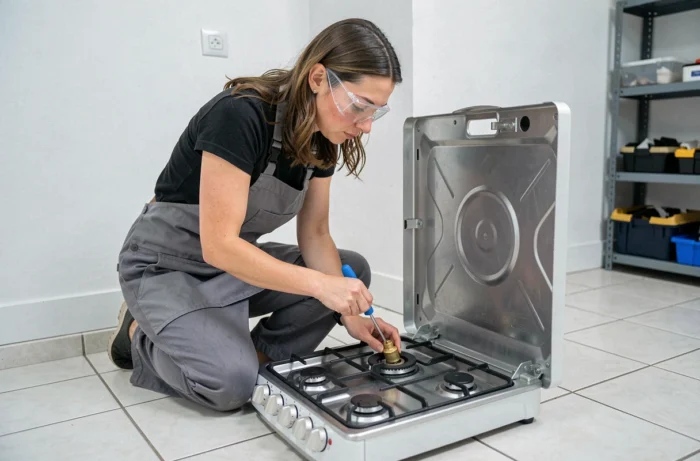
Even if nothing technically prevents you from changing your injectors yourself, documenting the intervention and testing for leaks protects both the installation and the occupant.
The choice between G20 and G30 is not complex once you have identified your gas type and consulted the appliance manual. What makes the difference between a successful change and a problem is the care taken in the installation: correct diameter on the right burner, air adjustment, verified sealing. The injector costs a few cents, but the rigor of installation is priceless.