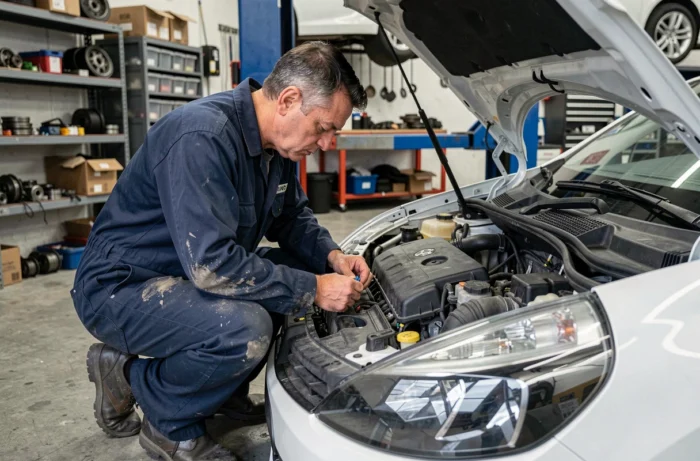
When connecting a trailer to a Renault Scénic or a Dacia Duster diesel and the DTC038061 code appears, the first reaction is often to order a set of glow plugs. On newer engines, this reflex can lead straight to a new part that doesn’t solve anything. The problem sometimes lies elsewhere, and the specificity of this code deserves attention before reaching for the toolbox.
Glow Plug Voltage and Engine Mapping: Why DTC038061 Traps DIYers
On older 1.5 dCi engines (type K9K), glow plugs operated under a standard voltage of 11 to 12 V. The ECU simply checked a fairly broad resistance threshold. Replacing a faulty glow plug with almost any compatible reference was enough to turn off the warning light.
Newer engines, particularly the 1.5 Blue dCi shared among Renault, Dacia, Nissan, and some Mercedes models, use low voltage residual glow plugs. These plugs are calibrated around 4.6 V, with extended post-heating that continues to warm the combustion chamber after starting to limit cold emissions.
The ECU manages this preheating strategy much more precisely. It monitors the current consumed by each plug and compares the measured resistance to a specific mapping.
If an 11 V plug is installed on a circuit designed for 4.6 V, the DTC038061 code returns despite new plugs. This is the most common trap on forums, and the reason diagnosing the dtc038061 on Renault and Dacia requires checking the exact reference of the plug before any intervention.
Glow Plug Relay and Wiring: The Number One Cause on Older dCi Engines
On K9K and F9Q engines, which still equip a large portion of the Renault and Dacia fleet on the road, the glow plug relay (sometimes called the glow plug control unit) is identified as the primary cause of the DTC038061 code, ahead of the plugs themselves.
The relay controls the electrical supply to the plugs. When it wears out, it can send insufficient or intermittent current. The plugs heat poorly, the ECU detects a discrepancy, and logs the fault. The symptoms are the same as with a burnt-out plug: difficult starting in cold weather, white smoke from the exhaust, engine warning light on.
Check the Relay Before Replacing the Plugs
Before disassembling anything, start with a relay check using a multimeter. Measure the voltage output from the unit during the preheating phase (spiral light on the dashboard). If the voltage is unstable or absent on one or more wires, the relay is at fault.
The other point to inspect is the wiring between the relay and the plugs. On vehicles over eight or ten years old, oxidation of the connectors is common, especially in humid regions. A poor connection on a single wire is enough to trigger the code.
- Measure the voltage output from the relay during the preheating phase, engine off, ignition on
- Visually inspect the connectors on each plug: green or white traces indicate active oxidation
- Test the resistance of each plug individually (a healthy plug shows very low resistance, less than 1 ohm on older generations)
- Check the fuse dedicated to the preheating circuit, often located in the engine compartment
DTC038061 After Replacement: Common Diagnostic Errors
We often see owners who change all four plugs, clear the code with a diagnostic tool, and then find it reappearing a few days later. Several scenarios explain this situation.
The first, as mentioned: an incompatible plug reference with the ECU mapping. On Blue dCi engines, it is essential to use the manufacturer reference or its exact equivalent in voltage and resistance. Feedback on this point varies depending on the suppliers of aftermarket parts, but the risk of recurrence is real with a generic plug not specified for the low voltage circuit.
The second scenario concerns the glow plug control unit itself. On some K9K engines, the unit manages each plug individually. If the internal control circuit of one channel is faulty, replacing the corresponding plug will not change anything. The unit must be tested channel by channel.
The third scenario, rarer but documented, involves the wiring on the engine ECU side. A ground fault or a pinched wire in the firewall passage can generate a phantom code. This type of failure requires a methodical wiring follow-up, wire by wire.

Clearing DTC038061: OBD Tool and ECU Reset
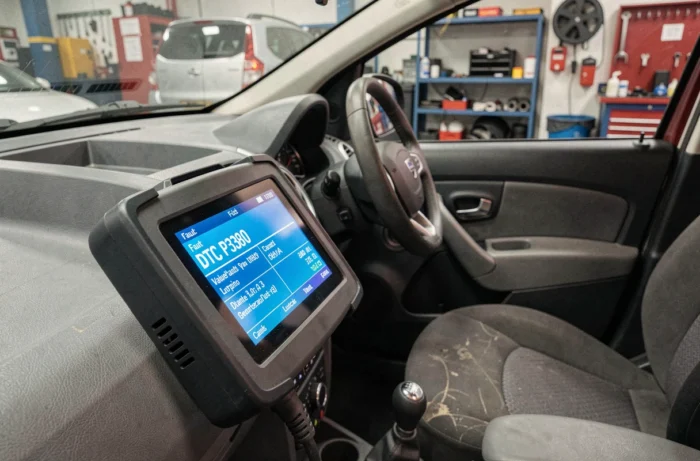
Once the repair is completed, the code does not disappear on its own. It must be cleared with a diagnostic tool compatible with the Renault/Dacia protocol. General OBD2 tools read the P0380 code (its standardized equivalent), but the DTC038061 is a specific manufacturer code. Some entry-level tools do not recognize it or cannot clear it.
After clearing, perform a complete preheating cycle: ignition on, wait for the spiral light to turn off, then start. If the code does not return after several cold starts over two or three days, the repair is validated.
- Use a tool compatible with Renault manufacturer codes (Clip, Delphi, or equivalent configured for the Renault group)
- Clear the code with the engine off, then perform at least three cold start cycles
- Monitor for any return of the code over a week, especially in low temperatures
On Blue dCi engines, post-heating lasts several minutes after starting. A code that reappears only after a few minutes of operation points to a post-heating problem rather than an initial preheating issue, which directs attention towards the control unit or ECU rather than the plugs.
The DTC038061 remains a code that resolves well when approached in order: check the plug reference, test the relay and wiring, then only replace the faulty parts. Skipping a step often means paying twice.