
Buying or selling real estate online refers to any transaction where the search, negotiation, signing, and sometimes the appearance before a notary take place on digital platforms. Since the widespread adoption of the electronic authentic deed in 2024-2025, this practice is no longer an exception: nearly all French notarial offices now use qualified electronic signatures, compliant with the eIDAS regulation revised in 2024.
Electronic authentic deed and remote appearance: what has changed
The recent regulatory shift has redefined the conditions for a dematerialized real estate transaction. The 2024 regulation clarified the cases in which an authenticated videoconference replaces the physical appointment at the notary’s office, including for identity verification, explanation of the deed, and obtaining consent.
In September 2024, a centralized national notarial platform was established to consolidate consultations, signatures, and tracking of deeds. This one-stop shop simplifies the process for both buyers and sellers, who can track the progress of their file without having to travel.
Another advancement: Article 20-1 of the decree of November 26, 1971, amended on October 1, 2025, allows the notary to establish a power of attorney on electronic support when the party is not present. Identity is verified through a substantial or high-level electronic identification method, which secures remote transactions without complicating the procedure. Consulting real estate on Veritaxis allows for cross-referencing this information with verified data on available properties.
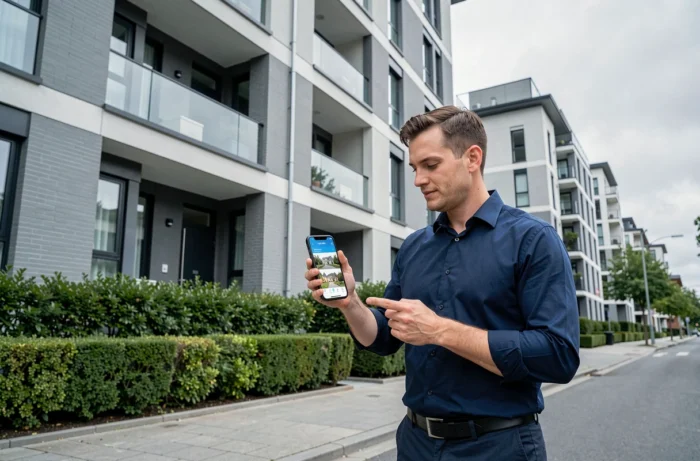
Online real estate listings: filtering the signal from the noise
The proliferation of listing portals creates a reliability issue. Between retouched photos, approximate surfaces, and prices disconnected from the real market, the online buyer must develop verification reflexes that are far from obvious.
Cross-check the displayed price with public data
Open databases, particularly the land value requests (DVF) available on data.gouv.fr, allow for comparing the price of a listing with recent transactions in the same neighborhood. This cross-check quickly reveals an inflated price or, more rarely, a good deal.
Check the technical consistency of the listing
Here are some checkpoints to systematically examine before requesting a visit, whether virtual or physical:
- Does the announced surface correspond to the Carrez law diagnosis mentioned? A discrepancy of several square meters indicates a deliberate approximation or an error in measurement.
- Is the displayed energy performance diagnosis (DPE) recent and compliant with current standards? An old DPE (before the 2021 reform) may mask degraded energy performance.
- Do the photos show all the rooms, or only the most advantageous ones? The absence of pictures of the bathroom or kitchen is a weak signal to take seriously.
A buyer who systematically cross-references listings and public data significantly reduces the risk of unpleasant surprises. This discipline takes a few minutes per property but avoids unnecessary visits and biased negotiations.
Remote signing of the sales agreement: steps and pitfalls
The sales agreement constitutes the decisive legal commitment. Signing it remotely does not change its significance: the buyer still has a legal withdrawal period, and the seller remains obliged to provide all mandatory diagnostics.
The electronic signature of the agreement generally goes through the secure platform of the notarial office or real estate agency. The notary verifies that each party has received and read the documents before affixing their qualified signature.
Specific points of vigilance for remote transactions
In person, the notary perceives non-verbal signals: hesitation, misunderstanding, pressure from a third party. Remotely, this reading disappears. The regulation therefore requires the notary to ensure, through individual exchanges in videoconference, that consent is free and informed.
The main risk remains identity fraud. The electronic power of attorney provided by the amended decree in 2025 mitigates this risk through substantial or high-level identification, but the buyer must verify that they are indeed communicating with a registered notarial office (official notary directory, CRPCEN number).

Interactive real estate sales: a regulated online auction format
The interactive real estate sale operates like a competitive bidding process among buyers on a digital platform. The seller sets a starting price, often below the estimated price, and candidates bid against each other for a defined period.
This format differs from traditional sales in several ways:
- Transparency on offers: each buyer sees the bids of others, eliminating the opaque negotiation between agent and buyer.
- Speed of the transaction: the bidding phase generally lasts a few days, compared to several weeks for a traditional sale with successive offers.
- The almost systematic exclusive mandate: the agent or notary organizing the interactive sale holds an exclusive mandate, which avoids duplicate listings and conflicts between intermediaries.
- The final price reflects the real market demand, without depending on the negotiation ability of a single buyer.
This format is not suitable for all properties. Very specific properties (isolated farmhouses, atypical assets) rarely attract enough candidates for the bidding mechanism to drive up the price. In contrast, for an apartment in a tight market area, the interactive sale often produces a selling price higher than that of a traditional negotiation.
Reliability of online price estimates
Automatic estimation tools rely on DVF data and comparison algorithms. Their accuracy varies significantly depending on location and property type. In densely populated urban areas with many recent transactions, the estimate can approach the actual price. In rural areas or for atypical properties, the gap between online estimates and actual selling prices can be very significant.
These tools remain useful as a first filter, not as a decision-making basis. The opinion of a notary or local real estate agent, even obtained remotely through an online consultation, provides a contextualization that the algorithm cannot offer: state of the local market, urban planning projects, quality of the neighborhood.
Online real estate transactions are gaining legal security each year, driven by notarial dematerialization and regulatory oversight. The challenge for both buyers and sellers is no longer whether buying remotely is possible, but mastering the verifications that make this practice reliable.