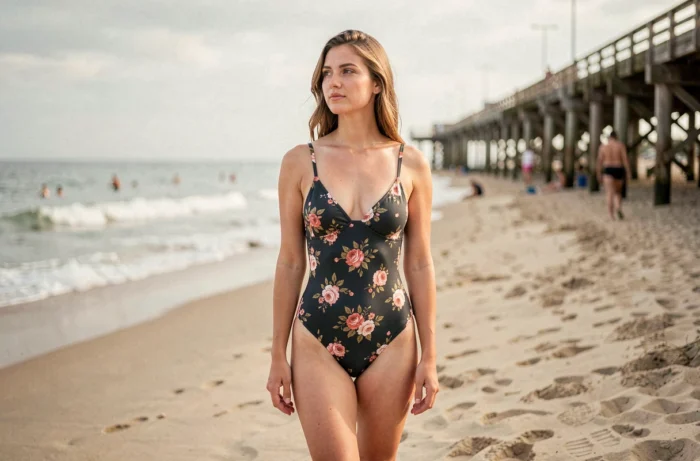
The swimwear market is undergoing a structural transformation. Ultra-reduced cuts, once confined to runways or Brazilian beaches, are now appearing in mainstream catalogs. This shift raises specific technical questions about pattern making, support, and health risks that most fashion articles overlook without addressing them.
Micro-bikini and Brazilian cuts: what pattern making really changes
A swimsuit labeled as “too small” is not always a sizing error. Since 2025, the micro-bikini has become a mainstream trend, driven by TikTok hauls and brands expanding their offerings with string cuts, high leg openings, and ultra-thin straps. The distinction between a poorly fitted swimsuit and a model designed to cover a minimal body surface has become blurred for the end customer.
We observe that Brazilian and Italian brands structurally size smaller than French brands. This is not a flaw: the pattern is designed for a reduced triangle of fabric, with flat seams and bi-directional elasticity that compensates for the smaller surface area. The problem arises when a buyer applies her usual size to a model whose cut geometry is radically different.
When discussing a woman in a too-small swimsuit, it is essential to distinguish three cases: the intentional stylistic choice of a micro cut, the mismatch between international sizing charts, and the swimsuit that is genuinely unsuitable for the body shape. Each calls for a different response.

Dermatological and gynecological risks of very tight swimsuits
Fashion articles address the discomfort of a too-small swimsuit from the perspective of red marks and straps that dig into the skin. The medical aspect goes much further.
A tight synthetic fabric kept damp creates an environment conducive to vulvo-vaginal infections. Recent gynecological and dermatological analyses remind us that the combination of heat, humidity, and compression promotes the proliferation of Candida. A wet swimsuit worn for several hours on the beach amplifies this risk, especially with string cuts where the fabric remains in close contact with mucous membranes.
From a dermatological standpoint, a case-control study (1986) showed that women who wore bikinis between the ages of 15 and 24 had a significantly higher risk of trunk melanoma than those wearing more covering one-piece swimsuits. The micro-bikini exposes areas usually protected (inguinal folds, sub-mammary groove) to direct UV radiation without most users applying sunscreen to these surfaces.
- Vulvo-genital area: damp and tight synthetic fabric promotes mycoses and irritations, especially after several hours of continuous wear
- Exposed skin folds: very high-cut styles reveal areas rarely protected by sunscreen, increasing the risk of actinic damage
- Prolonged compression: thin straps and narrow elastics cause friction dermatitis, sometimes mistaken for allergic reactions to the fabric
Sizing charts and elasticity: why the same number doesn’t yield the same swimsuit
The sizing issue in swimwear is primarily a textile engineering problem. A polyamide-elastane bikini with a high percentage of elastane stretches in water and over time. A swimsuit fitted when dry can become loose after three swims. Conversely, a model with a low elastane content in a tight weave will not forgive a size discrepancy.
Sizing charts vary significantly from one producing country to another. A Brazilian size M rarely corresponds to a French size M. Brands that offer mix and match (top and bottom in separate sizes) provide a concrete solution: choosing a cup size that fits the bust and a bottom that fits the hips, without forcing the whole into a single size.
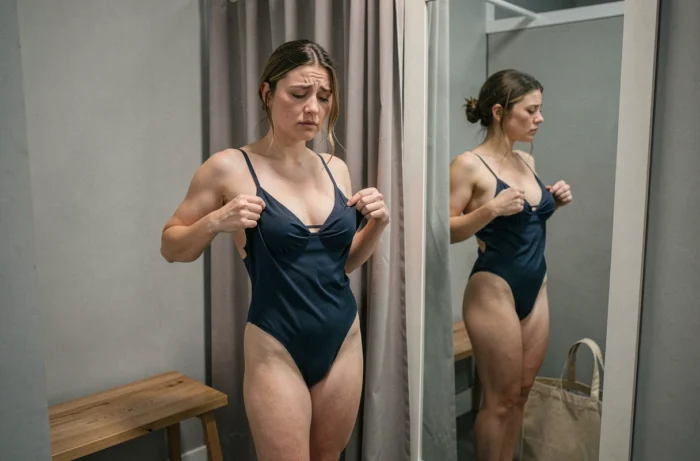
Check the fit in three points
- Back measurement: the band should remain horizontal without riding up in a V. If it rides up, the band is too small, not the cup
- Cup or triangle: no lateral overflow at rest and in motion. A slight fold of empty fabric indicates a cup that is too large, not good support
- Bottom: the elastics should not create a visible indentation in the skin after five minutes of wear. The high-cut Brazilian style is designed to hug the buttock fold, not to compress the top of the hip
Style and support: cuts that reconcile boldness and comfort on the beach
We recommend separating two often-confused objectives: showing skin and wearing a too-small swimsuit. A well-tailored high-cut style offers as much boldness as a model one size smaller, without the mechanical or health disadvantages.
High-cut styles visually elongate the legs while covering the belly. Bandeaus with integrated underwire provide breast support that string triangles cannot offer. The choice of colors and prints also plays a role: a contrasting print on a small area of fabric attracts the eye just as much as an ultra-reduced cut.
For generous busts, a model with wide straps and a molded cup remains the technical foundation. Brands that offer sizes by cup (and not by S/M/L) allow for an adjustment that eliminates the temptation to go smaller to “hold” the bust.
The swimsuit is the garment where the gap between perceived size and actual size has the most significant consequences. A well-fitted model in a bold cut will always be more flattering, healthier, and more durable than a too-tight swimsuit worn out of habit or ignorance of sizing charts.