
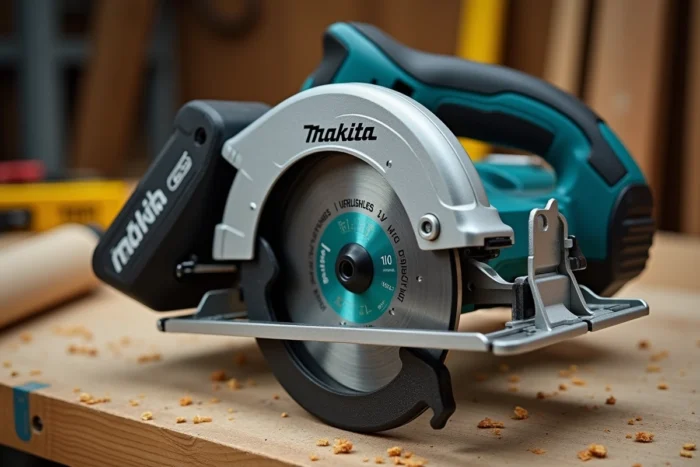
The Makita DHS680Z runs at 5,000 RPM thanks to an 18 V LXT brushless motor, accepts a 165 mm blade, and offers cutting capacities of 57 mm at 90° and 41 mm at 45°. These specifications are well-known. What deserves a closer look is the actual behavior of this machine on-site, its limitations compared to the new 40 V platforms, and the points of caution that product sheets do not mention.
Sole and Squareness: The Weak Point to Watch on the DHS680Z
The aluminum sole of the DHS680Z is generally rigid, but a shock is enough to misalign the front support. We observed this issue on several units used in real conditions. The result: cuts that drift from square, sometimes subtly, detectable only with a precision protractor.
The good news is that adjustment can be done without specific tools. The front sole support can be manually straightened and then checked with a carpenter’s square. We recommend this systematic check after any drop of the tool, even a slight one.
This flaw is not a dealbreaker, but it distinguishes the DHS680Z from magnesium sole circular saws that are more resistant to deformation. On a job site where the machine changes hands, checking squareness should be part of the daily routine.
We detailed this point in our review of the Makita DHS680Z, where the realignment procedure is illustrated step by step.
Brushless Motor and Automatic Speed Control: Behavior Under Load
The brushless motor of the DHS680Z features a system of automatic speed control that adjusts the speed based on the material’s resistance. On soft conifers, the machine runs freely and preserves battery life. On hardwood or laminate, the speed is maintained without the user having to manually compensate for feed pressure.
In practice, this system works correctly in most situations. The cut remains clean on medium thicknesses. Where the limit appears is on deep cuts in dense wood at full capacity (57 mm at 90°). The 18 V motor then reaches a torque ceiling that the new 40 V XGT platforms (like the HS012) significantly push beyond.
For repeated cuts in full-thickness oak, the DHS680Z requires a slower feed rate. This is not a design flaw; it is the physical limit of an 18 V platform. The DHS680Z excels in finishing work and standard carpentry, not in intensive hardwood cutting.
Real Battery Life with 18 V LXT Battery: What Makita Does Not Specify
Makita markets the DHS680Z in a “Z” version, meaning bare tool, without battery or charger. This commercial choice assumes that the buyer already has the LXT ecosystem. This makes sense for an equipped professional, but is less obvious for a craftsman starting their tool collection.
Battery life directly depends on the capacity of the battery used. With a high-capacity battery, we observe sufficient endurance for half a day of intermittent cuts on a finishing job site. For continuous cuts in formwork panels, this time is significantly reduced.
- Cuts in soft conifers (rafters, battens): low consumption, comfortable autonomy for a work session
- Particle boards or MDF: moderate consumption, need to plan for a spare battery for a full day
- Hardwoods (oak, beech) full thickness: high consumption, two batteries recommended minimum
The electric brake, which stops the blade almost instantly with each release of the trigger, also contributes to consumption. This is the price of safety, and on this point, the DHS680Z makes no compromises.
DHS680Z Compared to Recent Models: Proven Mid-Range or End-of-Cycle Machine
The DHS680Z remains in the Makita catalog, which means guaranteed supply of parts and accessories. It has not been replaced by a direct model in the 18 V range. However, there is internal competition.
The DHS660, more compact and lighter, targets users who prioritize maneuverability over cutting capacity. The HS012 in the XGT 40 V platform offers superior torque and pushes the limits of cutting depth. The DHS680Z stands as the versatile 18 V reference, neither the lightest nor the most powerful, but the one that covers the broadest spectrum of common situations.

For a carpenter or drywaller already equipped with LXT batteries, the DHS680Z remains a rational choice. The cutting quality, safety (lock button, electric brake), and compatibility with the existing ecosystem work in its favor.
- Ideal profile: finishing craftsman, layout carpenter, self-builder with existing LXT stock
- Profile to steer elsewhere: carpenter cutting solid wood in series, user seeking maximum cutting depth
- Internal Makita alternative for heavy work: XGT 40 V range, notably the HS012
The DHS680Z is no longer the most recent machine in the Makita catalog, but it remains the most balanced 18 V circular saw in the LXT range. Its brushless motor, 165 mm blade, and safety system make it a reliable tool for common cuts. The main point of attention remains the sole, which should be checked regularly. For those who do not need the brute power of 40 V, it continues to fulfill its role without major compromises.