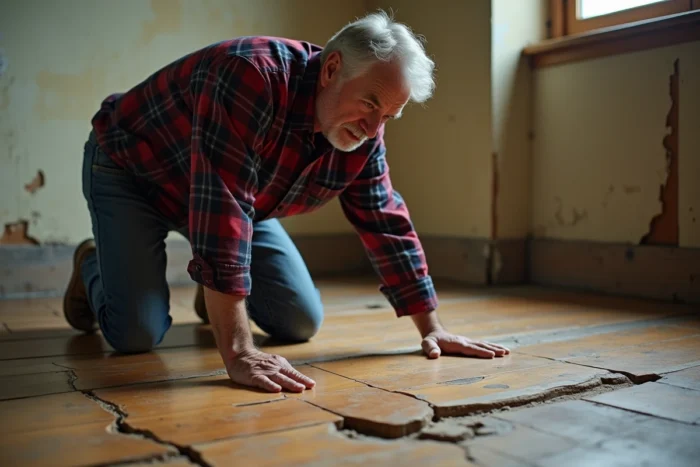
A floor that flexes underfoot, tiles that lift without apparent reason, a door that suddenly rubs against its frame: these manifestations often indicate a loss of load-bearing capacity of the ground. A fragile floor refers to a structure whose load-bearing materials (joists, beams, slab) no longer fulfill their function of load distribution, whether the cause is biological, mechanical, or related to moisture.
Floor Flexing and Soil Movements Related to Drought
Most guides describe cracks and slopes as isolated symptoms. They overlook an aggravating factor that is gaining prominence: the cycles of drought and rehydration of clay soils cause ground movements beneath foundations, and these movements directly affect the floors.
On clay soil, prolonged drought leads to ground shrinkage. The structure settles unevenly. The floor becomes unlevel, horizontal cracks appear at the base of walls, and level differences arise between two adjacent rooms. When the rains return, the ground swells, but not uniformly. This seasonal back-and-forth stresses the load-bearing materials much faster than simple aging.
For buildings located in clay areas, systematic photographic monitoring of deformations is now recommended. Photographing suspicious areas with a scale object (a coin, a ruler) allows for documenting changes and providing actionable data to a structural engineer. Identifying warning signs of a fragile floor also involves this geological context, which is too often overlooked during a simple visual inspection.

Moisture Levels and Deterioration of Load-Bearing Materials
Moisture is the primary accelerator of degradation in wooden floors. A high moisture level promotes both the rotting of joists and the development of mold beneath the flooring. The problem develops out of sight, in the crawl space or between the subfloor and the covering.
Several signals should raise alarms:
- A persistent musty smell in a room, even after airing out, indicates fungal colonization beneath the covering. Molds weaken structural wood and degrade indoor air quality.
- A flooring that buckles, lifts, or peels without apparent cause indicates moisture migration from the subfloor. The load-bearing material below absorbs water and loses its rigidity.
- The presence of fine sawdust at the base of joists or beams may signal an attack by wood-eating insects (powderpost beetles, longhorn beetles) or carpenter ants, whose activity is favored by ambient moisture.
- Recurring condensation marks on lower walls, associated with a floor that seems soft, point to a ventilation issue in the crawl space.
Measuring the moisture content of wood with a pin moisture meter remains the most reliable action to objectively assess the risk. Beyond the critical threshold, wood loses its mechanical strength and the structure becomes vulnerable long before a visible sign appears on the surface.
Crack Monitoring Protocol for an Old Floor or Building
Not all cracks are equal. A superficial micro-crack on a coating does not have the same significance as a through-crack on a load-bearing wall or a crack that progresses month by month. It is the evolution of a crack that determines its severity, not its initial size.
Monitoring practices have been structured in recent years. Placing a plaster witness across the crack remains a simple and effective method: if the plaster cracks, the crack is active. For more precise monitoring, a crack meter (graduated gauge glued on either side) allows for measuring the opening to the nearest tenth of a millimeter.
Cracks to Monitor as a Priority on a Floor
The most concerning cracks are those that appear in a star pattern around a load point (base of a partition, post), those that follow a horizontal line at the bottom of a wall (a sign of foundation movement), and those that widen after a drought or freeze episode.
A reliable protocol includes dating each observation, photos with a scale object, and at least seasonal readings. This data allows a structural diagnostic professional to assess whether the movement is stabilized or progressing.
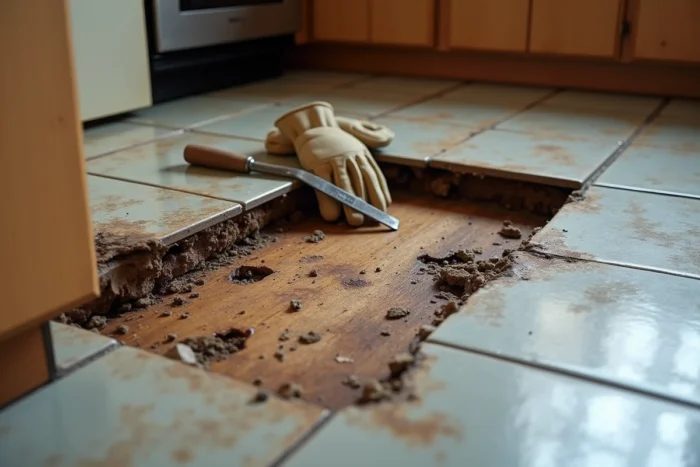
Sensory and Behavioral Signals Not to Ignore in a Building
Beyond cracks and moisture, certain everyday signals deserve attention.
- A floor that vibrates abnormally when walked on, especially upstairs, may indicate undersized joists or weakening due to partial rot.
- Unusual and repetitive creaking sounds, distinct from normal thermal expansion noises, sometimes signal a gradual failure of wood joints.
- Doors or windows that stick or deform in their frames indicate a shift in the load-bearing structure. This symptom often appears before visible cracks.
A round object placed on the floor that consistently rolls in the same direction reveals a slope. This rudimentary test helps detect a settling that the naked eye may not always perceive.
A floor that exhibits several of these symptoms simultaneously requires a professional diagnosis, not just a cosmetic repair. A common mistake is to treat the surface covering (patching, covering) without checking the condition of the load-bearing elements beneath. In an old building, a structural diagnosis identifies the cause before deterioration compromises the safety of the occupants.