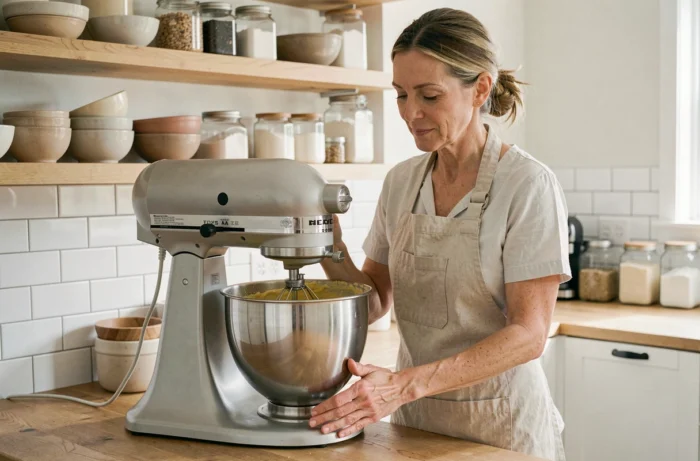
We prepare a brioche for the next morning and, at the moment of kneading, the dough sticks everywhere in the bowl of the food processor. The hook skids, the temperature rises, and the result is compact. With a planetary mixer, the same dough would have risen effortlessly.
This kind of situation often cuts through the debate better than any technical sheet. Stand mixer or Thermomix, the choice depends primarily on what you actually cook, not on what you imagine cooking.
Kneading and Pastry: Where the Stand Mixer Remains Superior
When you regularly make bread, pastries, or yeast doughs, the planetary stand mixer has no equivalent. Its kneading hook works the dough deeply, develops the gluten network over a long period, and supports heavy loads without straining the motor.
A Thermomix or multifunction food processor can mix cake batter, whip egg whites, or prepare pastry cream. However, as soon as it comes to kneading elastic dough for ten minutes, its rotating blades and heated bowl do not replicate the mechanical work of a planetary arm.
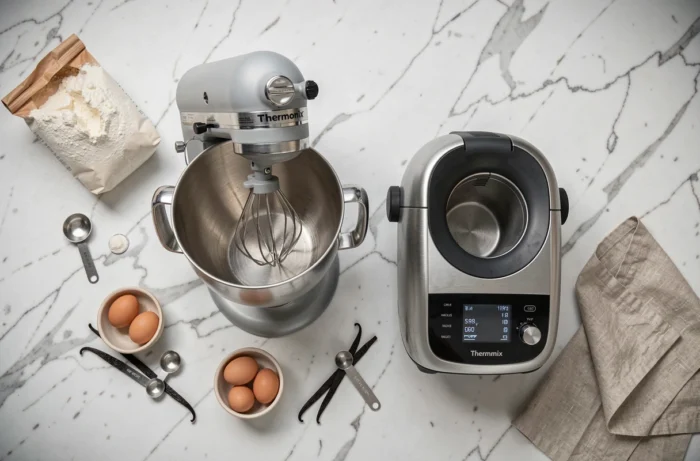
We can summarize the logic as follows: for textures that require kneading or prolonged whipping (Italian meringue, pizza dough, inverted puff pastry), the stand mixer wins in precision and consistency. To know how to choose between a stand mixer and a Thermomix based on your recipes, you must first honestly list what you prepare each week.
Integrated Cooking and Everyday Meals: The Domain of the Food Processor
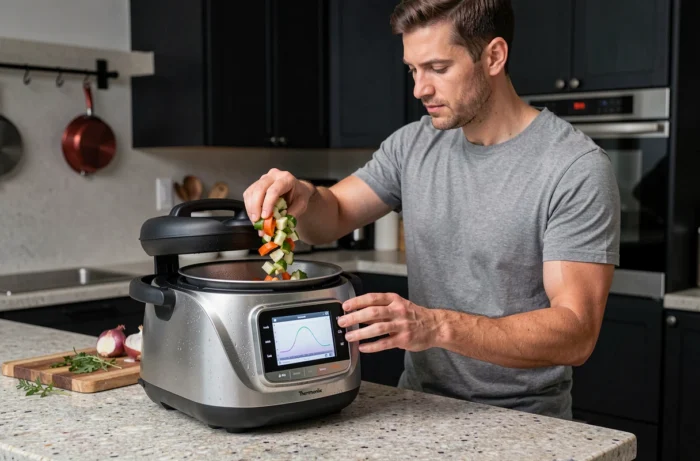
The Thermomix-type food processor makes the most sense when preparing complete meals during the week. Risotto, soup, simmered tomato sauce, steamed vegetables: integrated cooking eliminates pots and supervision. You set it up, attend to something else, and the result is reproducible.
A classic stand mixer (KitchenAid Artisan, Kenwood Chef, Magimix) does not cook. You need to transfer the preparation to a pot or an oven. For someone who primarily cooks savory dishes daily and bakes a cake occasionally, the food processor meets more needs.
Multifunction Features: What Really Works
Food processors often advertise dozens of functions. In practice, we regularly use a handful:
- Simultaneously blending and heating for soups and sauces, resulting in a smooth texture without extra dishes
- Steaming with the dedicated basket, convenient for vegetables, fish, or dumplings alongside the main dish
- Weighing directly in the bowl, simplifying the tracking of guided recipes and reducing the number of utensils
However, searing or caramelizing functions are limited by the shape of the bowl and heat distribution. Feedback on this point varies by model and brand.
Motor Power and Bowl Capacity: The Specs That Matter
On product sheets, you find power figures and bowl volumes. Not all are equal depending on the intended use.
For a stand mixer, motor power determines the ability to knead heavy doughs without overheating. An entry-level model with a modest motor will be suitable for light cakes but will struggle with bread dough. Artisan or Chef-type models offer more robust motors and a bowl with sufficient capacity for family recipes.
For a food processor, heating power and temperature regulation precision matter more than raw blending power. A bowl that is too small forces you to cook in two batches, negating the promised time savings.
Accessories: Initial Investment and Long-Term Cost
The stand mixer stands out for its ecosystem of accessories: meat grinder, pasta roller, citrus juicer, vegetable slicer. Each accessory transforms the machine into a specialized tool. The investment spreads over time as you purchase according to your needs.
The Thermomix comes with a complete kit upon purchase (knife, steaming basket, spatula, measuring cup). Additional accessories are rare and specific to the brand. The entry price is significantly higher, but you get a functional device right out of the box.
Repairability and Lifespan: A Visible Criterion
Since the AGEC law of February 10, 2020, a repairability index rated out of 10 must be displayed in stores and online for several categories of household appliances, near the price. A 2024 decree gradually introduces a durability index that adds criteria for reliability and robustness.
This regulatory framework changes the game when comparing two devices. A stand mixer with a metal construction, where the gears and motor are accessible, generally shows better repairability than an integrated electronic device where everything is soldered. Before purchasing, checking this index on the product sheet gives a concrete indication of the device’s longevity.
The absence of compliant display can lead to administrative penalties for the seller, prompting brands to document the availability of spare parts. A repairable device costs less over ten years than a disposable model, even if its purchase price is higher.
Stand Mixer or Thermomix: Comparison Table by Use
| Criterion | Stand Mixer | Food Processor (Thermomix) |
|---|---|---|
| Kneading heavy doughs | Very effective (planetary motion) | Limited (rotating blades) |
| Integrated cooking | Absent | Yes, with temperature regulation |
| Guided recipes | No | Yes, integrated screen on recent models |
| Expandable accessories | Wide range (meat grinder, pasta roller, etc.) | Kit included, few extensions |
| Footprint | Moderate, often stays on the countertop | Comparable, taller bowl |
| Repairability | Generally good (mechanical parts) | Variable by model |
The choice rarely boils down to “better” or “worse.” Someone who makes bread three times a week and a cake on Sundays needs a sturdy stand mixer. Someone who wants to prepare a complete meal in less than an hour every evening will find more value in a food processor. And in a small shared apartment, one well-chosen device is better than two poorly used ones.