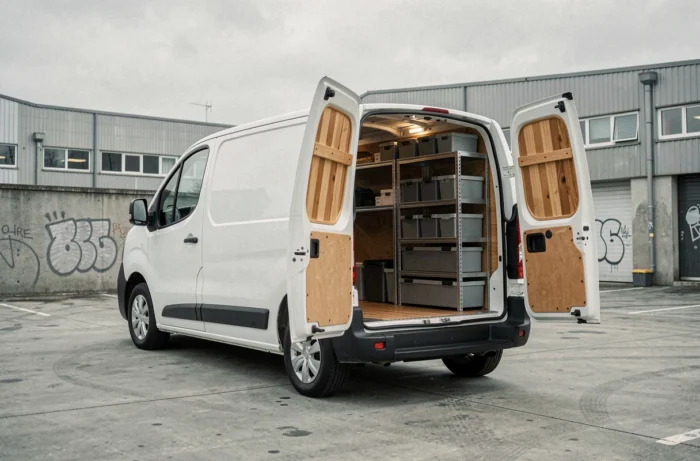
The Peugeot Expert remains one of the most widespread compact vans among craftsmen, mobile technicians, and small fleets. Its compact size (M or XL length depending on the version) requires precise layout choices to avoid losing useful volume. Since the decree of March 13, 2020, utility layout kits are approved by type in the name of the manufacturer, and their installation is reserved for authorized professionals. This regulatory constraint conditions part of the solutions listed here.
1. Non-slip wooden floor covering the entire loading area
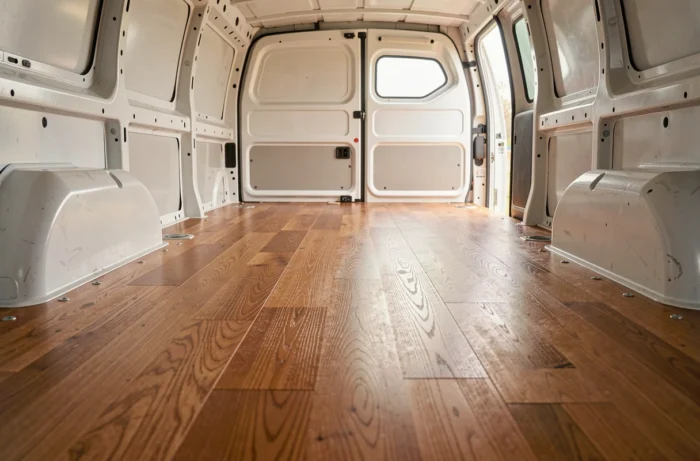
Installing a non-slip plywood floor protects the original sheet metal from scratches and deformations. A well-fitted floor also facilitates the sliding of boxes and storage bins during loading.
Film-coated birch floors remain the reference for professional utility vehicles. The non-slip film glued to the surface limits the need for straps for light loads. Opting for a custom cut adapted to the wheel arches of the Peugeot Expert avoids lateral play that generates noise while driving.
2. Wall coverings in honeycomb polypropylene
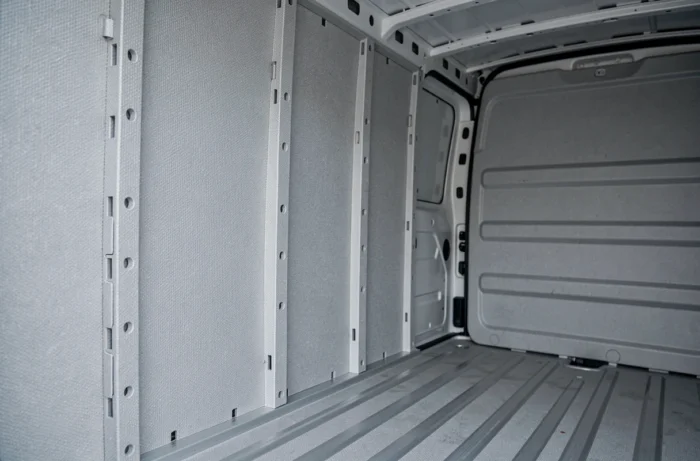
The covering in honeycomb polypropylene panels (often referred to as PP honeycomb) covers the side walls, rear doors, and pillars. This material absorbs light shocks and protects the interior bodywork from corrosion caused by tools or transported materials.
In terms of Peugeot Expert utility layout, wall coverings often constitute the first step before any installation of furniture or shelves. A well-installed covering also adds slight sound insulation, which is appreciated on long trips.
3. Modular aluminum shelves mounted on rails
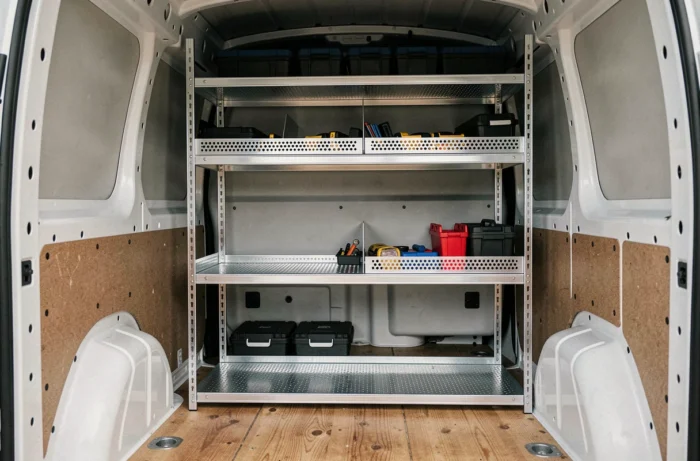
Aluminum shelf systems mounted on rails allow for reorganizing storage without drilling new holes in the bodywork. Manufacturers like Alaska offer specific ranges for the Peugeot Expert, with profiles adapted to the van’s interior dimensions.
The aluminum rail allows for quick repositioning of the shelves according to the nature of the load. An electrician has different needs than a plumber, and modularity avoids multiplying vehicles or fixed configurations.
4. Foldable workbench for on-site interventions
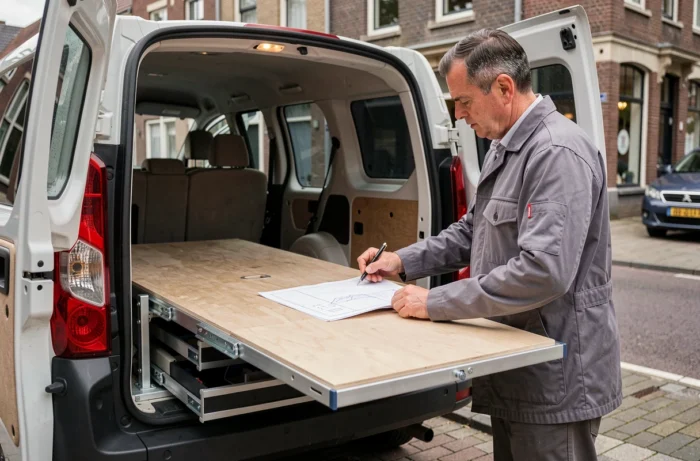
A foldable workbench fixed to the side wall or floor transforms the Peugeot Expert into a mobile workshop. When unfolded, it provides a stable work surface for measurement, cutting, or light welding operations.
Field feedback varies on the ideal thickness of the top. A top that is too thin vibrates under load, while a top that is too thick reduces the available space when folded. The thickness should be calibrated based on the weight of the tools permanently placed on it.
5. Standardized stackable storage bins
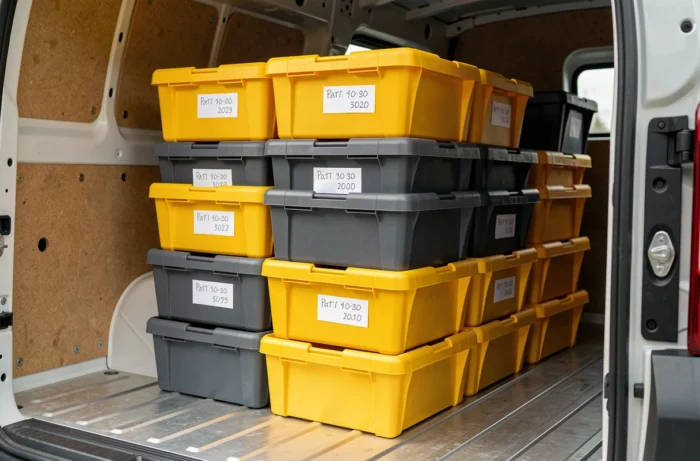
Using bins with standardized dimensions (Eurobox type) allows for stacking containers without wasting space. These bins fit directly on shelves or on the floor, and their standardized format makes them interchangeable from one vehicle to another.
A color code by trade or type of part speeds up searches during interventions. This organization may seem trivial, but it reduces trips between the vehicle and the worksite.
6. Mesh partition between cabin and loading area
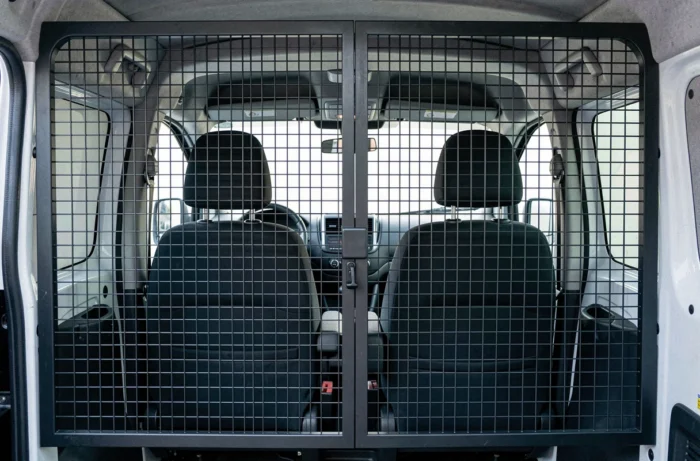
The mesh partition protects cabin occupants in the event of sudden braking. It is a regulatory requirement whenever heavy loads are transported without individual securing. The grid allows light and ventilation to pass through, unlike solid partitions.
For the Peugeot Expert in extended cab configuration (with rear bench), the partition is mounted behind the second row of seats. Checking compatibility with original fixings prevents weakening the structure.
7. Roof rack with load bars
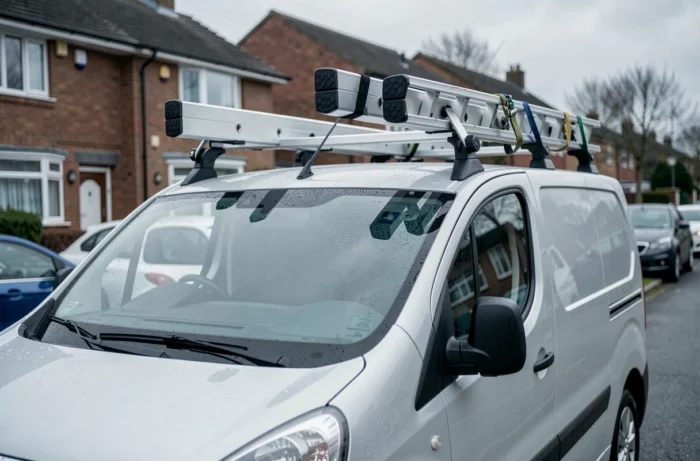
The roof rack frees up the interior of the van by transferring long loads (ladders, tubes, profiles) onto the roof. The crossbars distribute the weight and prevent deformation of the sheet metal.
The Peugeot Expert in M version has a size that fits in most underground parking lots without a rack. With a loaded rack, the total height often exceeds the limit displayed in covered parking lots. A point to check before each urban trip.
8. 230 V socket and onboard electrical kit
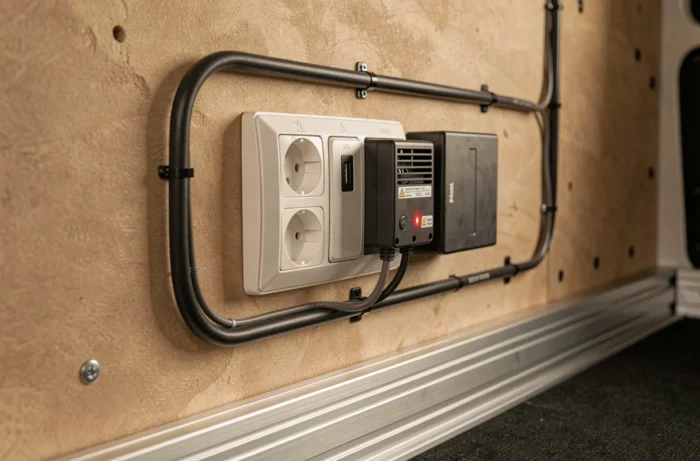
Installing a 230 V socket powered by an inverter allows for plugging in electric tools directly from the vehicle. The kit generally includes a pure sine inverter, a circuit breaker, and secure wiring connected to the auxiliary battery.
Some points to check before installation:
- The power of the inverter must match the maximum consumption of the most power-hungry tool (drill, grinder, compressor)
- The auxiliary battery must be sized to avoid discharging the starter battery
- The wiring must comply with the minimum cross-sections imposed by low voltage electrical standards
9. Specific layout for transporting glass or panels
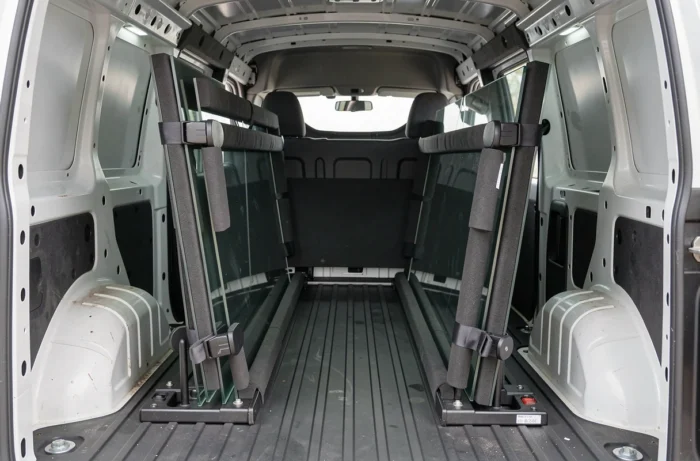
Carpenters and glaziers need secure vertical support for panels and glass. Padded cradles fixed to the wall keep fragile pieces in an upright position during transport.
The interior width of the Peugeot Expert allows for transporting standard panels. The foam support combined with ratchet straps distributed along the height of the load limits the risk of breakage, even on rough roads.
10. Lightweight thermal insulation for mixed work-camping layouts
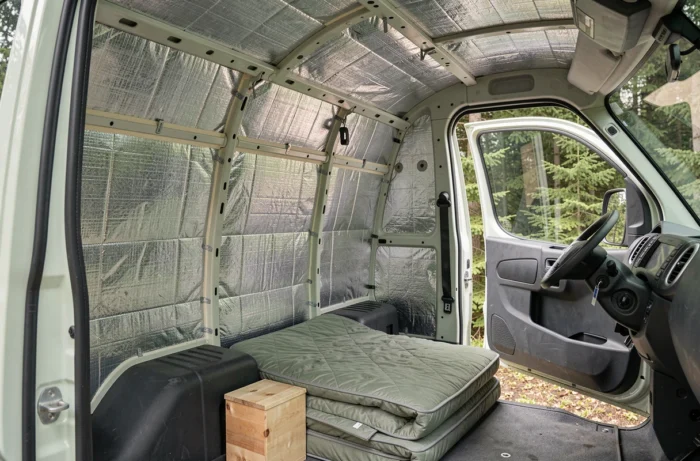
Some users combine professional use during the week with camping on weekends. Lightweight thermal insulation (such as Armaflex or multilayer insulation) installed between the sheet metal and the covering reduces condensation and maintains an acceptable temperature in the cabin.
Insulation does not exempt from proper ventilation: without ventilation, humidity concentrates between the insulation and the sheet metal and accelerates corrosion. One or two roof vents are sufficient to create a minimal airflow.
Each layout of the Peugeot Expert depends on the trade practiced and the type of load transported. Since 2020, regulations require that kits be approved by type and installed by an authorized installer. Before ordering a kit or starting work, checking regulatory compatibility with the manufacturer remains the first concrete step.