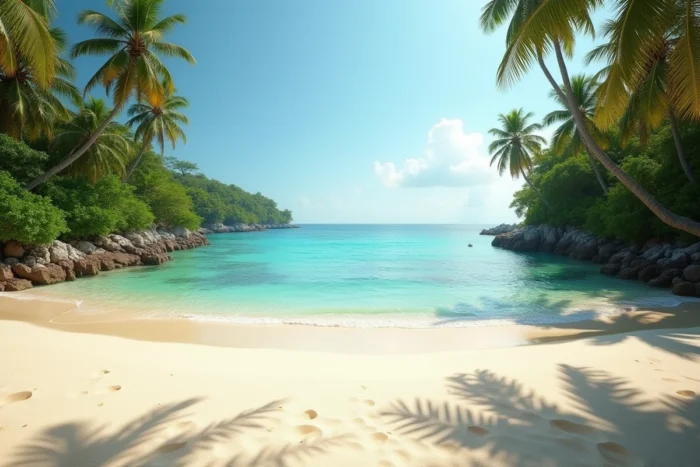
The beaches of Guadeloupe are experienced differently at 7 AM than at 2 PM. The time you lay down your towel determines the quality of the light, the state of the sea, the level of crowds, and even the presence or absence of showers. Here we detail the time slots that truly change the beach experience on the archipelago.
UV Index and Surface Temperature: Why the Slot Before 10 AM Changes Everything
In the tropical zone, the UV index peaks between 11 AM and 2 PM. At this latitude, the solar intensity far exceeds that of metropolitan beaches, even in summer. Before 9-10 AM, exposure remains moderate, the low-angle light offers superior visual comfort, and the ground heat has not yet made the sand scorching.
The sea maintains a stable temperature around 28 °C during the green season (June to November), but it is in the morning that the surface remains the smoothest. The trade winds strengthen throughout the day, especially on the exposed coasts of Grande-Terre. On a beach like Sainte-Anne or La Caravelle, the difference in wave action between 8 AM and 1 PM is significant.
By arriving early, you also benefit from clearer water. The foot traffic on sandy bottoms and midday water activities disturb visibility, especially in the shallow coves of the lagoon. For snorkeling, we recommend prioritizing these early hours.
You can check the schedules of Guadeloupean beaches on Conceze to adjust your outings to the time difference with the mainland.

Green Season in Guadeloupe: Adjusting Beach Hours to Showers
From June to November, the rainfall pattern of the archipelago follows a predictable scheme. Mornings are often bright. Showers, short but intense, concentrate in the late afternoon, sometimes as early as 3-4 PM. Local sources like Guadeloupe Authentique document this rhythm and advise to schedule outdoor activities early in the day.
The most reliable strategy during the wet season is to divide the day into two blocks:
- Beach and water activities in the morning, ideally between 7 AM and 12 PM, when the sky remains clear and the swell is manageable.
- Indoor activities in the afternoon (markets, distilleries, museums) to avoid tropical downpours without wasting time.
- Return to the coast in the late afternoon, around 5-6 PM, if the shower has passed, to enjoy the sunset on the Caribbean side (Basse-Terre, Deshaies, Bouillante).
This organization is not just a comfort tip. Tropical showers cause runoff currents on some black sand beaches of Basse-Terre, temporarily reducing swimming quality. It’s better to have left the water beforehand.
Local Crowds and Attendance Slots at Guadeloupean Beaches
Tourist articles describe the beaches of Guadeloupe as if they were permanently deserted. The reality is different. Residents flock to certain coves, especially on weekends and during local school holidays (academic calendar for the Antilles-Guyane zone, which is out of sync with the mainland).
Arriving before 10 AM on Saturdays and Sundays is the only way to comfortably settle on beaches like Petit Havre (Gosier) or the Bourg de Sainte-Anne. After this hour, parking fills up and shaded spots under the coconut trees are taken.
During the week, the pressure is lower. But on the iconic spots of Grande-Terre, the 11 AM-3 PM slot remains the busiest, between groups of tourists on organized excursions and locals on lunch breaks. We observe that the 7 AM-10 AM slot during the week offers the best tranquility-swimming conditions ratio, regardless of the spot.
Particular Case of the Beaches of Basse-Terre
On the Caribbean side, the black or reddish sand beaches (Grande Anse in Deshaies, Malendure in Bouillante) attract a different crowd, often focused on diving and hiking. The attendance rises later in the morning, around 10 AM-11 AM, as visitors combine the Traversée road and the coast. If you target these coves, an early departure from Pointe-à-Pitre or Sainte-Anne gives you a good hour’s head start.

Sunset on Caribbean Beaches: The Underestimated Slot
The end of the day remains an underutilized slot by visitors, who often return to their hotels after 4 PM. On the west coast of Basse-Terre, the sun sets over the Caribbean Sea. The golden light that precedes the sunset, between 5:30 PM and 6:30 PM depending on the season, completely transforms the atmosphere.
At this hour, the air temperature drops, the wind often weakens, and the sea regains a relative calm. The beaches of Deshaies and Bouillante are particularly suited to this slot. Grande-Terre, facing east, does not benefit from this sunset over the water, which directs the choice of the spot according to the intended time.
A technical point: in the tropical zone, the transition from day to night is rapid. Dusk lasts about twenty minutes. Bring a flashlight for the return if you are on a beach without public lighting, which is the case for most wild coves.
The choice of time slot weighs as much as the choice of the beach itself. A well-known spot visited at 1 PM under maximum UV, crowded and swept by the trade winds, does not offer the same experience as the same place at 8 AM, with calm sea, cool sand, and oblique light. Adjusting your alarm by two hours sometimes does more for the quality of a stay in Guadeloupe than the choice of the destination.