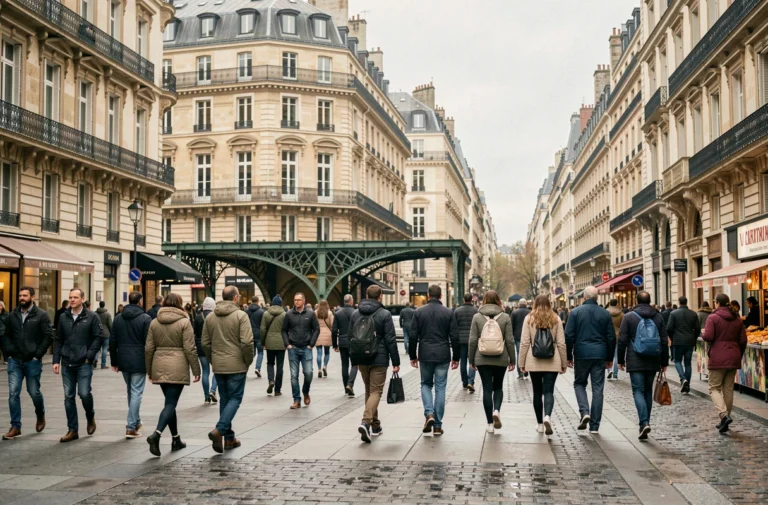
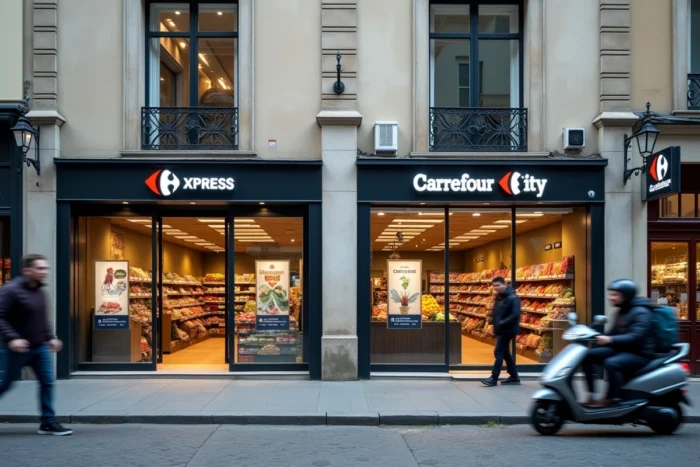
Carrefour City and Carrefour Express carry the same brand, share the same logo, and often sell the same private label brands. However, these two proximity formats of the Carrefour group do not target the same locations or shopping habits. Comparing their size, range, and price level allows you to choose the store suited to your daily shopping needs.
Comparison Table: Carrefour City vs. Carrefour Express
The table below gathers the criteria that concretely separate the two brands in the field.
| Criterion | Carrefour City | Carrefour Express |
|---|---|---|
| Typical Location | City center, busy thoroughfares | Residential neighborhoods, high-traffic areas (train stations, metro stations) |
| Sales Area | Larger, wider range | Smaller, limited assortment |
| Food Assortment | Developed fresh produce section, bulk fruits and vegetables, frequent integrated bakery | Quick convenience offer, essential products |
| Non-Food | Small hygiene section, drugstore, stationery | Very limited or even absent |
| Opening Hours | Wide hours, often open Sunday mornings | Wide hours, sometimes open late in the evening |
| Price Level | Higher than traditional supermarkets, but slightly lower than Express | Among the highest in Carrefour formats |
| Management Mode | Franchise or integrated depending on the location | Very often franchised |
To better understand the differences between Carrefour Express and Carrefour City, one must go beyond the surface and examine what each format implies for the average basket.
Price Level in Carrefour Proximity Stores: What Comparisons Show
Rankings published by UFC-Que Choisir between 2024 and 2026 regularly place the proximity brands of the Carrefour group in the upper part of the price ranking, far from the most competitive brands like E.Leclerc. This observation holds true for both Carrefour City and Carrefour Express.
The logic is structural. A small store in the city center bears high rent, more frequent restocking, and low storage capacity. These costs are reflected in the prices.
In contrast, Carrefour City generally has a higher sales volume than Carrefour Express due to its larger size and more consistent customer flow. This volume allows for prices that are slightly below those practiced in Express for private label products.
Carrefour Express remains the most expensive format in the group for a typical basket. Its positioning assumes the role of convenience: the customer buys few items, often in a hurry, and price sensitivity is lower than in larger stores.
Product Range and In-Store Experience
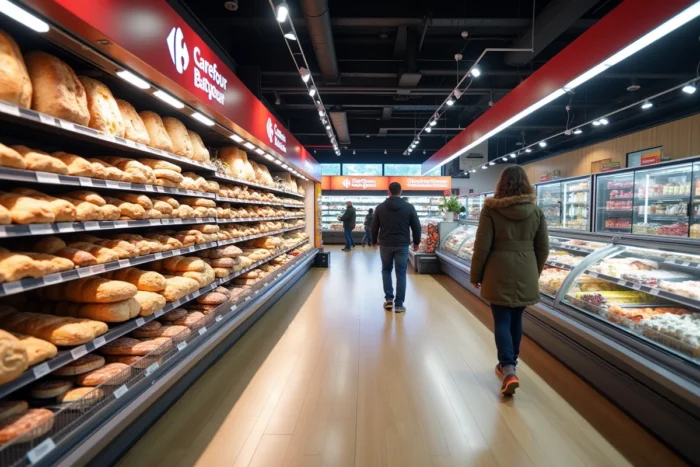
The most noticeable difference in daily life is the depth of the offer. Carrefour City offers an assortment that resembles a small supermarket, with several notable characteristics:
- A self-service fruit and vegetable section, often restocked daily, with a minimum of ten references.
- A bakery-pastry area (cooking terminals) present in most locations.
- A sufficient catering and prepared meals offer to compose a complete meal without going to another store.
Carrefour Express, due to its more compact format, functions more like a convenience store. The fresh section exists, but it is limited to a few references of vacuum-packed deli meats, pre-packaged cheeses, and yogurts. Bread most often comes from an external supplier, not from an on-site cooking terminal.
In non-food, the gap widens further. Carrefour City includes a small shelf of hygiene, household products, and sometimes stationery. Carrefour Express reduces this offer to the bare minimum (a shower gel, a toothpaste, tissues).
Opening Hours and Accessibility in the City
Both brands rely on extended hours compared to traditional supermarkets. Opening on Sunday mornings is common in both cases, and some Carrefour Express stores remain open late in the evening, sometimes beyond 10 PM depending on local regulations.
The geographical distribution differs. Carrefour City targets shopping streets and high pedestrian traffic areas. In some cities, there is a Carrefour City every few hundred meters in the city center. Carrefour Express prefers to locate in high-traffic areas: near train stations, metro stations, and office zones.
This location strategy explains why Carrefour Express can offer more flexible hours more often: its typical customer shops after work or while in transit, not during a planned shopping trip.
Which Format to Choose Based on Your Usage
The choice between the two formats depends on the nature of your purchases. Here are the most common scenarios:
- For a supplement to weekly shopping (fruits, vegetables, bread, a few fresh products), Carrefour City offers a sufficient assortment to avoid a detour to the supermarket.
- For a quick and occasional purchase (drink, sandwich, forgotten product), Carrefour Express fulfills its role of convenience without detour.
- For regular shopping with a tight budget, neither format competes with a supermarket or a drive. Proximity prices remain structurally higher than those of larger stores in the same group.
The City format resembles a small Carrefour Market in miniature. The Express format resembles an upgraded kiosk. The boundary between the two lies in size, depth of range, and ultimately, the amount on the receipt. Adapting the store to the nature of the purchase remains the only way to limit the extra cost associated with proximity.