
The Assimil method for Arabic targets a beginner audience with an objective of A2 level, according to the notice from the Montpellier media library. The format is based on progressive lessons, recorded dialogues, and corrected exercises. What do users who have worked with this material really say, and where are its concrete limitations?
Skills developed by Assimil Arabic: listening, reading, and expression
User feedback on audio methods like Assimil converges on a recurring observation. Listening and pronunciation improve significantly, especially in the first few weeks. The recorded dialogues, available in USB MP3 or streaming, allow for independent oral comprehension practice.
However, reading Arabic and true writing autonomy remain weak points if the method is not supplemented with other materials. This imbalance is documented in comparative analyses of audio methods for beginners in Arabic.
| Skill | Progress with Assimil alone | Need for supplement |
|---|---|---|
| Listening comprehension | Strong | Weak |
| Pronunciation | Strong | Weak |
| Initial automatism | Good | Moderate |
| Reading Arabic | Limited | High |
| Written expression | Weak | High |
| Free conversation | Limited | High |
This table reflects a classic pattern of structured audio methods. Several testimonials compiled on the Assimil Arabic method on Yakaz Emploi confirm that oral skills are solid, but transitioning to independent reading requires additional work.
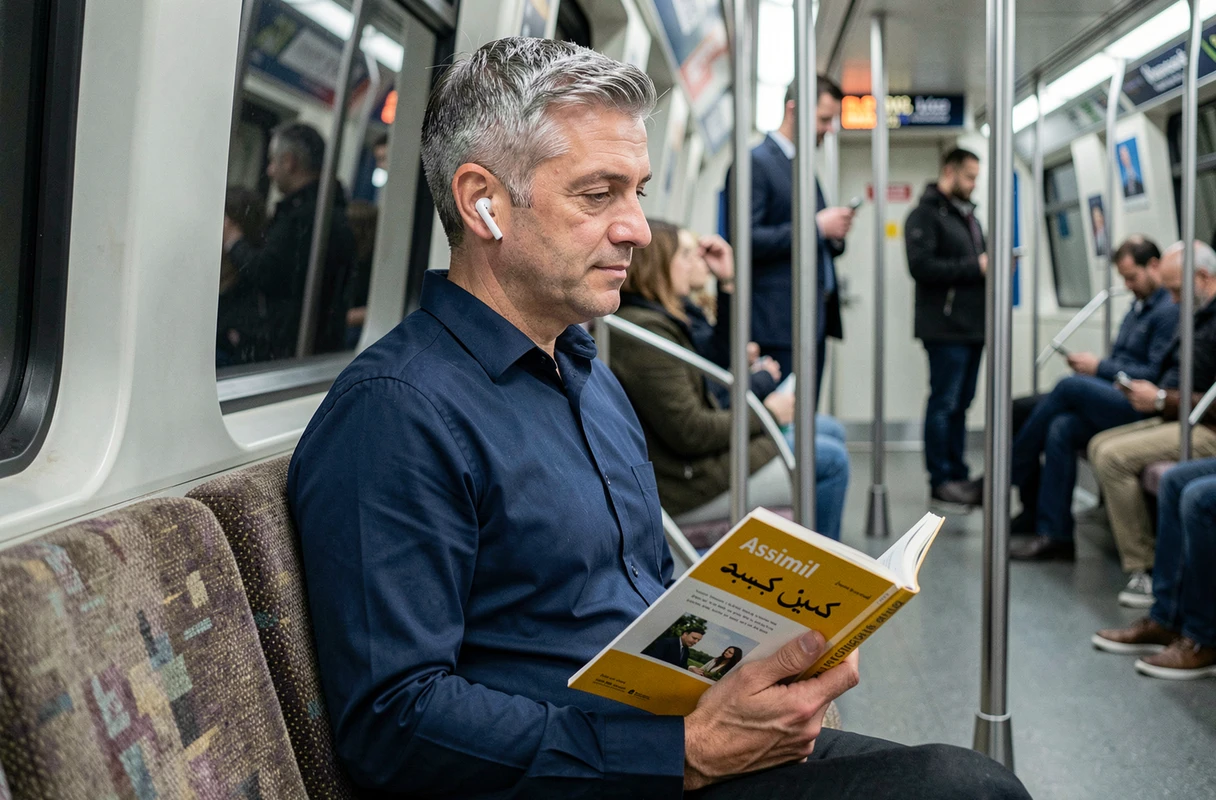
Format of Assimil Arabic lessons: what users remember
The Arabic method from Assimil is structured into progressive lessons, with practical corrected exercises integrated into each chapter. The recommended pace is one lesson per day, and most feedback indicates that a session lasts between twenty and thirty minutes.
The principle is based on two phases. The first, called the immersion phase, involves listening to and reading the dialogues without trying to memorize everything. The second, the activation phase, requires the learner to actively produce the learned structures.
Points appreciated by users
- The gradual progression that avoids cognitive overload, a benefit often cited by true beginners who have no background in the Arabic alphabet
- The audio recordings available in USB MP3 and streaming, which facilitate listening on the go without relying on a CD player
- The corrected exercises at each lesson, which allow for checking understanding without needing a teacher
The USB MP3 edition has replaced the CD format in the current offering, making the material more accessible on smartphones or computers. This point frequently appears in recent reviews.
Level achieved with Assimil Arabic: A2 and beyond
The method explicitly aims for an A2 beginner level of the European framework. Users who complete all the lessons generally report the ability to understand simple exchanges and formulate short sentences on everyday topics.
The gap between A2 and a level that allows reading a newspaper article or following a sustained conversation remains wide. Feedback on comparable methods, such as Pimsleur Arabic, highlights the same limitation: initial automatism is acquired, but full autonomy requires additional resources.
What the method does not cover
Assimil Arabic teaches Modern Standard Arabic. Local dialects (Moroccan, Egyptian, Levantine) are not addressed. For a learner who wishes to communicate in a specific Arabic-speaking country, this distinction has a direct impact on the practical usefulness of the acquired skills.
Arabic grammar, with its declensions and verbal morphology, is introduced gradually but in a simplified manner. Several users note that a dedicated grammar manual becomes necessary after completing the program to consolidate the basics.

Assimil Arabic versus mobile applications: different uses
Applications like Mondly or other digital tools for learning Arabic operate on a model of gamified micro-lessons. In contrast, Assimil offers a linear and structured path, without a points system or rewards.
- Mobile applications favor isolated vocabulary and spaced repetition, with very short sessions
- Assimil prioritizes complete dialogues and comprehension in context, with longer sessions
- Applications offer navigation flexibility (choosing a theme), while Assimil imposes a sequential order lesson by lesson
The two formats do not target the same learning habits. Users who combine Assimil with a vocabulary app report better retention than those who use only one resource.
The entry price also differs. Assimil represents a one-time purchase (book and audio), while most applications operate on a monthly subscription basis. Over time, the total cost depends on the learner’s consistency.
Data converge on a simple observation: Assimil Arabic effectively fulfills its role as a starting method to reach an A2 level in listening comprehension and pronunciation. Reading, writing, and grammatical mastery require supplements. The learner who calibrates their expectations within this scope gets the most out of it.