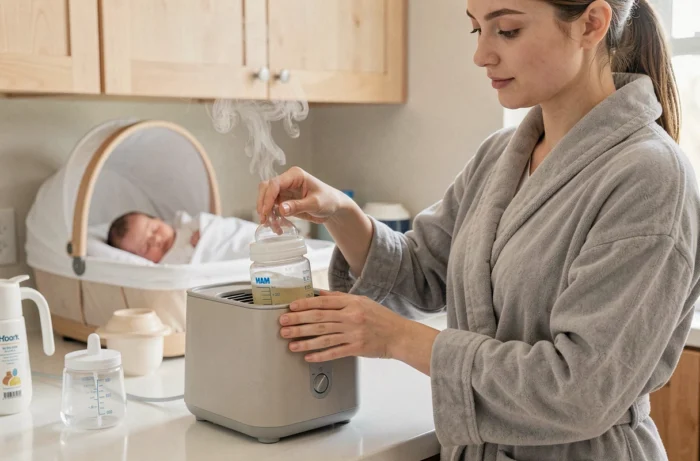
The MAM Anti-Colic bottles feature a medium diameter neck, wider than a standard neck but slightly below the so-called “wide” necks of some competing brands. This sizing aspect determines the choice of bottle warmer: not all devices labeled “universal” can properly accommodate a MAM 260 ml bottle with its screwed ventilation base.
Neck Diameter and MAM Ventilated Base: The Technical Constraint to Check First
The specificity of MAM bottles lies in their removable ventilated base, located under the bottle. This part adds a few millimeters to the total diameter of the bottom section. A bottle warmer whose heating chamber is calibrated only for narrow cylindrical bottles risks jamming the bottle or preventing uniform thermal contact with the water or steam.
We recommend measuring the outer diameter of the MAM bottle, with the screwed base, before any purchase. Bottle warmer models that accept containers up to about 6 cm in width generally cover the MAM range, but this information should be included in the device’s manual. Recent product sheets (summer 2026) from several manufacturers explicitly mention MAM compatibility, making verification easier.
To identify a bottle warmer compatible with MAM bottles, we advise cross-referencing the announced chamber width with the exact model of bottle used (160 ml, 260 ml, glass or plastic), as the dimensions vary from one reference to another.
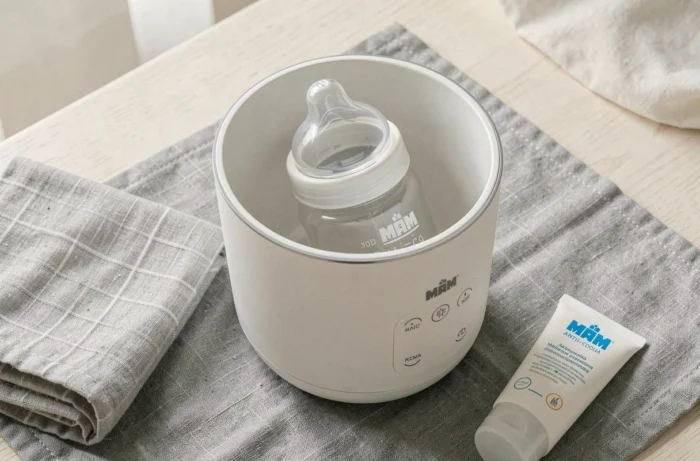
Steam or Water Bath Bottle Warmers: Impact on Breast Milk and MAM Bottles
The heating principle is not just a matter of speed. It directly affects the preservation of nutrients in breast milk and the thermal stress on plastic.
Steam: Rapid Temperature Rise, Caution on the Ceiling
Steam devices heat in just a few minutes. This speed requires a reliable thermostat. Health recommendations included in daycare breastfeeding protocols set a temperature ceiling of 37 °C for breast milk. Beyond this, immunoglobulins and certain enzymes degrade.
A steam bottle warmer without automatic shut-off exposes the milk to localized overheating, especially if the MAM bottle is partially filled. We observe that models equipped with a cycle-end shut-off sensor limit this risk.
Water Bath: Gradual Rise, Better Control
The electric water bath heats more slowly, but the gradual temperature rise remains more uniform. For a glass MAM bottle (Feel Good range), the water bath reduces thermal shock. For a plastic MAM bottle (BPA-free polypropylene), the difference in stress is minimal, but temperature control remains finer.
The microwave is prohibited for breast milk by French health authorities. It creates invisible hot spots in the liquid, posing a burn risk for the infant and accelerating the degradation of the biological components of the milk.
Safety Criteria and Applicable Standards in 2026
Bottle warmers sold in France must meet electrical safety requirements and overheating protection. The standard applicable to household electrical devices has been recently revised, incorporating updated criteria for liquids intended for infants.
When choosing a device, three points deserve particular attention:
- Automatic shut-off at the end of the cycle: prevents overheating if the parent is busy. Some models then keep the bottle at temperature for a limited time.
- Sound or light signal at the end of heating: allows for quick intervention, especially at night.
- Absence of BPA in parts in contact with steam or water: the polypropylene of MAM bottles is guaranteed BPA-free, but the bottle warmer itself must also meet this requirement for its internal parts.
A device compliant with the updated 2026 standards offers a higher level of protection than older models, particularly regarding maximum temperature management.

MAM Portable Bottle Warmer: USB, Car Lighter, or Standalone
Parents who travel regularly need a portable device. The market offers three main power supplies for portable bottle warmers.
- USB: compatible with an external battery or a laptop, suitable for short trips. The heating power remains limited, with significantly longer heating times than a wired model.
- Car lighter (12 V): designed for the car, it heats faster than USB but remains dependent on the vehicle.
- Standalone (built-in battery): recent models include a rechargeable battery. They offer the best flexibility, at the cost of increased bulk and weight.
For a MAM 260 ml bottle, a portable bottle warmer with a built-in battery remains the most versatile when traveling. Ensure that the heating chamber accommodates the diameter of the bottle with its ventilated base, as some portable models are designed for narrower formats.
Maintenance of the Bottle Warmer and Longevity with MAM Bottles
Limescale is the main enemy of a bottle warmer, regardless of the heating principle. Deposits accumulate in the chamber and on the heating element, reducing thermal efficiency and prolonging heating times.
Regular descaling (diluted white vinegar or dedicated solution) preserves performance. The ventilated base of MAM bottles must be disassembled and cleaned separately: if milk residues settle there, they can contaminate the bottle during the next heating.
Cleaning the MAM ventilated base after each use prevents bacterial proliferation in the micro-perforations of the anti-colic system. This often-overlooked action is crucial for both hygiene and the choice of the device itself.
The choice of a bottle warmer for MAM bottles hinges on three concrete parameters: the width of the heating chamber, precise temperature control (with a strict ceiling of 37 °C for breast milk), and compliance with updated safety standards. A device that checks these three boxes will last several years, well beyond the breastfeeding period.