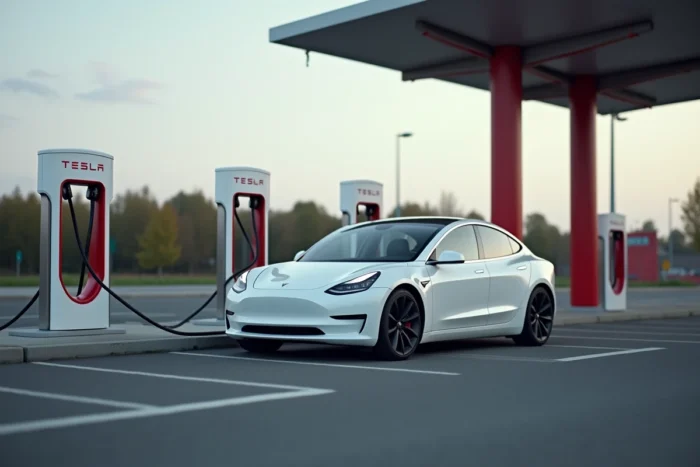
The Tesla Supercharger network relies on fast charging stations using direct current (DC), originally designed solely for the brand’s vehicles. Since the gradual opening of some stations to other manufacturers, this network also serves as an option for non-Tesla electric vehicle drivers, with access and pricing conditions varying by site and generation of charger.
V3 and V4 Chargers: What Changes at the Plug
Superchargers come in several generations. The V2 chargers, still present at some sites, share power between two adjacent stalls: two vehicles plugged into the same pair experience a decrease in charging speed. The V3 chargers eliminated this sharing, with each stall having its own dedicated power.
The V4 chargers bring a change in usage rather than just power. They feature a longer cable, compatible without an adapter with the CCS connector used by most European electric vehicles. At some V4 sites, a credit card payment terminal allows users to start a session without going through the Tesla app, simplifying access for drivers of other brands.
To understand which Tesla charging network corresponds to your vehicle, the generation of charger installed at the site makes all the difference.
Supercharger Pricing: Off-Peak Hours, Subscription, and Non-Tesla Surcharge
The price per kWh on the Tesla network is no longer uniform. Pricing is now segmented according to several criteria, and the actual cost of a session depends on the time of day as much as the vehicle used.
- Off-peak and peak rates vary from site to site, with significant differences between charging in the middle of the night and a session in the late afternoon on a busy route.
- Tesla owners benefit from a preferential rate compared to drivers of other brands, who pay a surcharge per kWh at multi-brand stations.
- A monthly subscription offered by Tesla helps reduce the kWh rate for frequent users, whether they own a vehicle from the brand or not.
- Occupancy fees apply if the vehicle remains plugged in after charging is complete, encouraging quick stall turnover.
This pricing logic makes comparisons with other operators (Ionity, Electra, Fulli) more relevant than before. Choosing a network is no longer just about charging speed: the cost per kWh varies greatly depending on the time and user profile.
Coverage in France: A Network Designed for Long Distance
The Supercharger network in France focuses on highways, major urban areas, and transit hubs. This deployment strategy prioritizes long-distance mobility, with stations spaced to cover a typical route without major detours.
The GPS integrated into Tesla vehicles automatically calculates charging stops on a route, taking into account battery level, estimated consumption, and station availability. The battery is automatically preheated before arriving at the Supercharger, optimizing charging speed as soon as plugged in.
However, coverage remains uneven outside major routes. Rural areas or secondary routes have few Superchargers, and charging there relies more on other networks or home charging via a wallbox or reinforced outlet.
Stations Open to Other Electric Vehicles
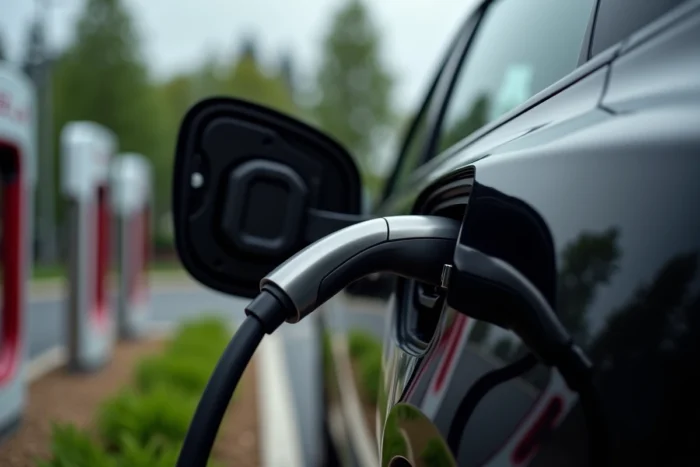
The opening of Superchargers to non-Tesla vehicles is progressing in France, but not all sites are included. The Tesla app or the dashboard screen of a Tesla vehicle indicates which stations accept other brands. At V4 chargers equipped with a payment terminal, the charging process for a non-Tesla vehicle resembles that of a traditional operator.
For drivers of other brands, access generally goes through the Tesla app, where they must create an account and register a payment method. Some multi-network charging cards are also starting to include Tesla stations in their coverage, simplifying roaming.
Home Charging and Superchargers: Two Complementary Uses
The majority of charging for an electric vehicle occurs at home, on a wallbox or reinforced outlet, with power significantly lower than that of a Supercharger. The Supercharger network is designed for roaming, not for daily charging.
Using a Supercharger daily is more expensive than home charging and accelerates battery wear due to repeated fast charges. Tesla recommends limiting fast charging to long-distance trips and prioritizing home installation for regular use.
Installing a charger at home requires a dedicated circuit and, depending on the desired power, the intervention of a qualified electrician. The cost per kWh for home charging remains significantly lower than that of a session on a Supercharger, regardless of the time of day.
The Tesla network continues to expand with V4 stations and the gradual opening to other brands. The choice between operators now hinges on the actual cost per kWh, connector compatibility, and the location of chargers relative to your usual routes, rather than just the displayed power.