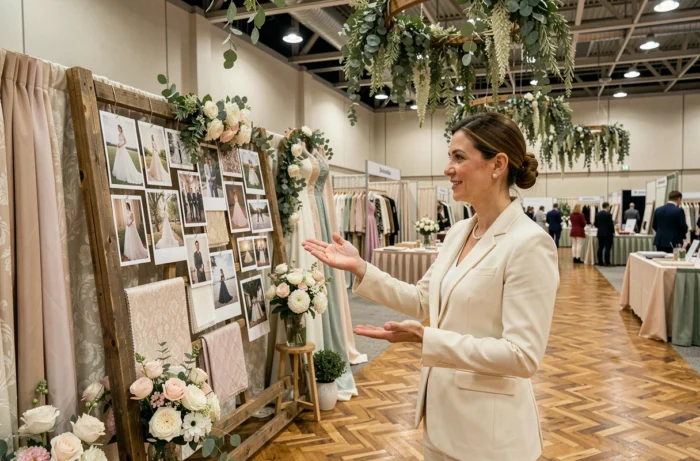
Comparing wedding service providers online gives a fragmented view: retouched photos, standardized quotes, exchanges via forms. Specialized fairs offer a setting where one can concretely measure the quality of a service, touch the materials, taste the menus, and evaluate the interpersonal relationship. The question for couples preparing their wedding is: what formats of fairs and what types of exhibitors provide real added value compared to traditional online searches?
Artisanal customization at fairs: what changes for future brides and grooms
The most noticeable evolution of specialized fairs in 2026 concerns the shift from a showcase model to a workshop model. In Muret, the 2026 edition included workshops where couples create their own wedding bands, design jewelry from sketches, or embroider their veil.
This format changes the relationship with the service provider. One no longer consults a catalog; one co-designs an object. For exhibitors, this means mobilizing time and materials at the fair, but the conversion rate is higher: a couple that starts working on a piece of jewelry on-site rarely returns to an online competitor.
The professionals present at salonfestimariage.com illustrate this logic: the direct connection between artisans and future brides and grooms allows for a creative dialogue that is impossible to reproduce in writing.
Wedding fair: comparison of formats based on the size of the event being prepared
Not all fairs cater to the same profile of couples. The expected number of guests radically changes the relevant service providers and the type of fair to prioritize.
| Criterion | General fair (large cities: Paris, Lyon, Bordeaux) | Regional or intimate fair (Muret, Sélestat, Vernon) |
|---|---|---|
| Average number of exhibitors | More than a hundred | Several dozen |
| Dominant profile of service providers | High-volume caterers, reception venues for 150+ guests, entertainment shows | Local artisans, custom services, independent creators |
| Targeted weddings | 100 to 250 guests | Around 80 guests or fewer |
| Participatory workshops | Rare (fashion shows, showcases) | Frequent (ring making, targeted tastings) |
| Promotional offers | Volume packages, discounts for early booking | Unit pricing, personalized quotes on-site |
Professionals interviewed in Muret confirm that requests for around 80 guests are becoming more frequent, down from 200 previously. Couples prefer to reduce the guest list rather than give up on service providers that suit them.
On the other hand, large fairs in Paris or Lyon remain relevant for large weddings, where logistics (catering, sound, transportation) take precedence over individual customization.
Wedding content creator: a new professional to spot at fairs
The Vows & Venues study conducted by Hyatt in 2026 indicates that 35% of future brides and grooms are looking for a specialized content creator to produce short videos and share behind-the-scenes moments of the wedding in real-time. This figure marks the emergence of a distinct budget line from traditional photographers and videographers.
At the fairs, this professional stands out by their approach: they do not deliver an album or a 20-minute film, but short formats designed for social media. Their work often begins during the preparations and continues on the big day.
What the content creator brings compared to the traditional videographer
- Capsules of a few seconds to a few minutes, edited and released on the same day or the next, while the photographer delivers their images several weeks later
- Coverage of behind-the-scenes (preparations, fittings, rehearsals) that the traditional videographer generally does not film
- A narrative-focused perspective: vertical shots, subtitles, rhythm adapted to sharing platforms
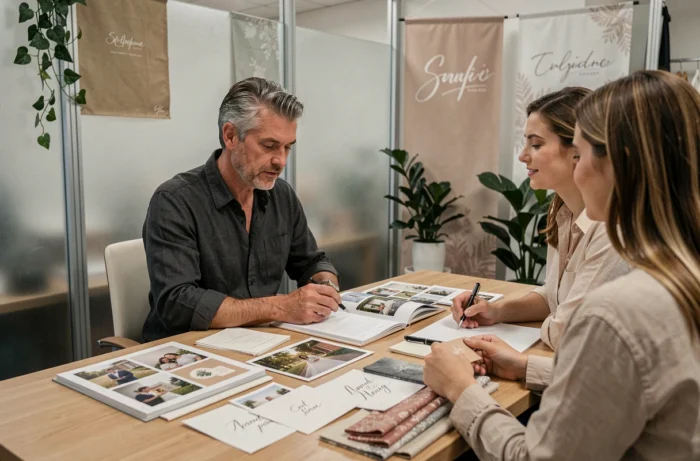
Spotting this type of service provider at fairs allows one to see their work on screen, assess their style, and verify their ability to integrate into the existing team (photographer, wedding planner).
Eco-friendly wedding: what specialized fairs allow you to verify on-site
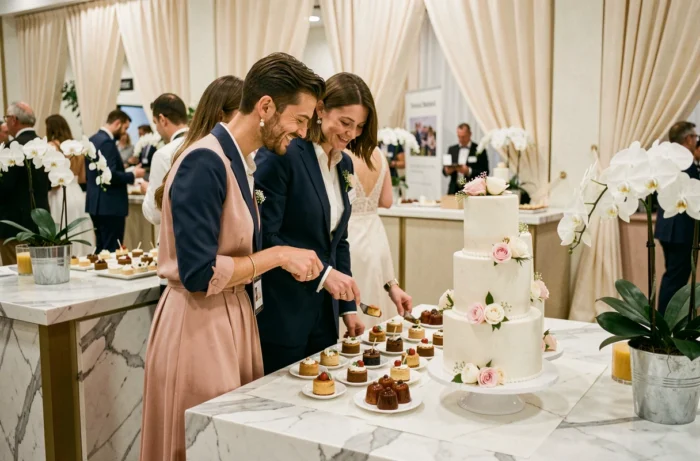
The eco-friendly trend is omnipresent in speeches, but a fair offers a concrete advantage: you can physically verify a provider’s commitments. Touching recycled fabric, tasting a local menu, examining decorations made from reused materials provides information that a website does not offer.
Several regional fairs now include a dedicated space for providers engaged in a sustainable approach. This ranges from seeded stationery to florists who work exclusively with seasonal French flowers.
Animations and ideas that can only be spotted at fairs
Interactive animations constitute another differentiation lever. Fairs allow testing experiences that online catalogs do not convey: personalized cocktail bars, photobooths with instant prints, olfactory workshops to create a couple’s fragrance.
Testing an animation before integrating it into the wedding program reduces the risk of disappointment on the big day. This is a decisive argument, especially when the budget is tight and every expense item must be validated in advance.
Data from the 2026 fairs confirm an underlying trend: couples are balancing the number of guests and the quality of services. Regional fairs, with their participatory formats and artisanal exhibitors, respond better to this logic than large general fairs. The content creator is emerging as a new budget line. And the physical verification of eco-friendly commitments remains an advantage that online research cannot replace.