
The practical driving test is based on a scoring grid capped at 31 points. Each point corresponds to a skill assessed by the inspector, and the passing threshold is set at a minimum of 20 points. Achieving the maximum score remains rare, but the gap between a candidate scoring 25 points and one scoring 31 is less about mastery of the vehicle than about a fine understanding of what the inspector observes and quantifies.
Evaluation grid for the driving license: point distribution by skill
The grid used by inspectors breaks down driving into several skills, each rated from 0 to 3. A score of 0 means the skill is not acquired, while a score of 3 indicates it is mastered without hesitation. The maximum total reaches 31 points, including bonuses.
| Evaluated skill | Scoring | What the inspector observes |
|---|---|---|
| Knowing and mastering one’s vehicle | 0 to 3 | Setup, adjustments, use of controls |
| Understanding the road | 0 to 3 | Reading signs, anticipating dangers |
| Sharing the road | 0 to 3 | Respecting priorities, safety distances, courtesy |
| Autonomy and risk awareness | 0 to 3 | Adapting driving, managing the unexpected |
| Manoeuvres | 0 to 3 | Parallel parking, reversing, U-turns |
| Bonus (eco-driving, courtesy) | Up to 1 point | Overall positive attitude throughout the course |
Most candidates lose points on skills related to sharing the road and autonomy. These are also the two categories where the inspector has the greatest leeway in judgment.
To delve deeper into the scoring criteria and the most common mistakes, you can achieve the 31/31 driving license with Net Actu by consulting their detailed analysis of each skill.
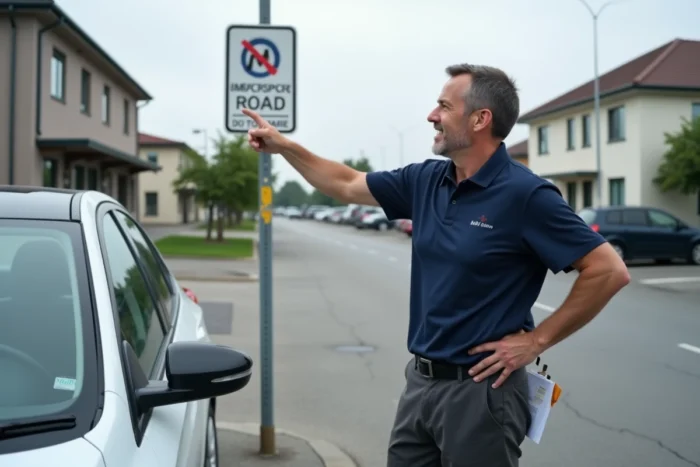
Eliminatory faults in the driving test: errors that nullify the score
A candidate can accumulate 28 points out of 31 and still fail. One single eliminatory fault is enough to invalidate the test, regardless of the number of points obtained otherwise. This is the most counterintuitive aspect of this test.
Eliminatory faults are not scored on the points grid: they appear in a separate column. The inspector records any behavior that endangers safety.
- Disregarding a stop sign or red light, including running a red light while entering the intersection
- Crossing a solid line, even partially, during an overtaking or turn
- Speeding excessively in relation to traffic conditions (not just in relation to the speed limit)
- Failing to yield to a pedestrian on a crosswalk, even if they hesitate
- Physical intervention by the accompanying person or inspector on the steering wheel or brake
The public road safety policy enhances inspectors’ vigilance regarding these major risks. In 2026, the recruitment of 20 additional inspectors aims to increase the number of exam slots and reduce waiting times, which also changes the conditions under which candidates present themselves.
Key skills for a 31/31 on the driving test
Three skills consistently separate candidates who are close to the perfect score from those who hover around 24 or 25 points.
Observation and anticipation
Observation determines the score in road apprehension. The inspector observes whether the candidate continuously scans the visual scene: mirrors, blind spots, looking far ahead. A candidate who fixates on the hood loses points even before making a trajectory error.
Anticipation is measured concretely. Lifting the foot before a tight turn, adjusting speed when approaching a school, slowing down when nearing a parked vehicle with its reverse lights on. Each micro-decision made in advance earns points.
Communication with other road users
Turn signals are not enough. The inspector also evaluates direct looks towards pedestrians, gestures of courtesy, and the vehicle’s position indicating intent. Letting a hesitant pedestrian pass earns a bonus point that many candidates overlook.
A candidate who clearly communicates their intentions reduces the risk of negative interpretation by the inspector. In contrast, a technically correct candidate but opaque in their intentions will lose points on sharing the road.
Stress management and fluidity
A stall at startup costs only one point, sometimes less. It is the recovery after the mistake that counts, not the mistake itself. The inspector notes the candidate’s ability to remain calm, shift to neutral, and restart without rushing.
The overall fluidity of driving weighs heavily in the scoring of autonomy. Gradual accelerations, anticipatory braking, smooth gear changes: these elements do not correspond to any isolated box on the grid, but they influence the score assigned to several skills simultaneously.

Planning the driving test date to maximize chances
With the arrival of new inspectors in 2026, the number of exam slots is increasing in several departments. This development allows candidates to choose a more favorable time slot rather than appearing at the first available date.
A final targeted training session the day before or the day before the exam, in the likely geographical area of the course, produces better results than an accumulation of driving hours spread over several weeks. The procedural memory of roundabouts, local right-of-way rules, and pedestrian zones specific to the exam area makes the difference between 28 and 31.
Avoiding late-day slots, where both the inspector’s fatigue and traffic density increase simultaneously, is common sense. Morning slots in the middle of the week statistically concentrate fewer complex traffic situations.
A score of 31/31 does not reward absolute technical perfection. It reflects safe, anticipated, and readable driving for the inspector. Each point on the grid measures observable behavior, and it is this readability, much more than virtuosity at the wheel, that separates the perfect score from a simply favorable result.