
On a classic practice range, you hit buckets of balls to correct a slice or work on a wedge. In Long Drive, you step up to an elevated tee, take an extended driver, and swing with everything you’ve got in a corridor a few dozen meters wide.
The ball that lands the farthest, including roll, wins. This raw format, halfway between golf and strength competition, has been gaining traction in Belgium for a few seasons.
Long Drive Equipment: What Changes Compared to Traditional Golf
The first shock when discovering the discipline is the equipment. A Long Drive driver looks nothing like the one you pull out of your bag on a par 5. The shaft is longer, often stiffer, and the loft of the head is calibrated to maximize carry in given wind conditions.
Players adjust their setup for each competition. Into the wind, they increase the loft to maintain backspin and lift. With a tailwind, they decrease the loft for a more penetrating trajectory that benefits from the push. You don’t play with just one driver all year round: the equipment settings change for each round.
The grip, the ball, the length of the shaft (which can exceed the 48 inches allowed in traditional federal competition) are also part of the variables. The Belgian community that is forming around this discipline regularly shares technical feedback on https://longdriversbelgium.be/, particularly on the configurations tested in real conditions.

Specific Physical Preparation for Long Drive in Belgium
You don’t produce swing speeds exceeding 200 km/h without targeted physical training. Long drivers combine heavy weightlifting (squats, deadlifts), plyometrics, and explosive trunk rotation exercises. The lower body generates the power, the trunk transfers it, and the arms and hands only guide.
The preparation resembles that of a discus thrower more than that of an amateur golfer. We’re talking about strength sessions three to four times a week, complemented by mobility work to protect the back and hips.
Common Mistakes Among Beginners
Many golfers who want to try Long Drive make the same mistake: they swing harder without changing their mechanics. Hitting hard with a course swing is the best way to get injured or send the ball out of the corridor.
- Neglecting ground anchoring: without stable support, the rotational speed of the hips drops, and the strike loses compression
- Forgetting the trigger sequence: the lower body must initiate the downswing before the shoulders, otherwise the club arrives open or closed
- Underestimating warm-up: high-velocity rotations on cold joints increase the risk of injury to the obliques and back
Feedback varies on this point, but several Belgian practitioners report that a coach specialized in swing biomechanics can yield more distance than changing drivers.
Long Drive Competitions Accessible from Belgium
Belgium does not yet have a structured national tour with a fixed calendar. There are occasional rounds integrated into club events or pro-ams, but no dedicated circuit comparable to what exists in Germany or the Netherlands.
The European Long Drive Association Tour has been multiplying stages across Europe for a few years, with dates in Germany, the Netherlands, and the UK. For a Belgian competitor, these travels remain reasonable in distance. Florent Roekaerts, crowned European Amateur Champion, used this circuit as a springboard, proving that the Belgian level can compete on a continental scale.
Women’s and Junior Categories on the Rise
Long Drive is no longer reserved for imposing physiques over 100 kilos. Women’s and junior categories are developing in Europe, with increasing distances and media coverage following suit (live broadcasts on specialized channels and video platforms).
On the Dutch-speaking side, Golf Vlaanderen has been communicating since 2024 about “power disciplines” (long drive, speedgolf, crossgolf) as recruitment levers in clubs, with evening events on certain courses. This approach opens the door to more varied profiles than the traditional golfer.
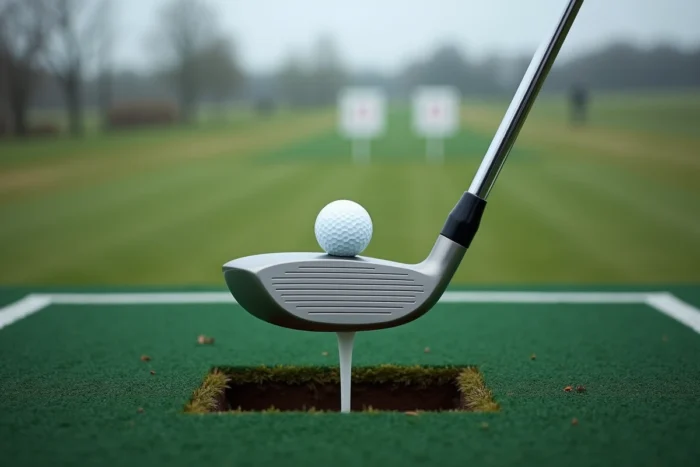
Long Drive and Course Golf: Two Disciplines, One Sport
Sometimes it is said that Long Drive has nothing to do with golf. This is inaccurate. The basic mechanics remain the same: hip rotation, weight transfer, releasing the club at the right moment. The difference lies in the intention: on a course, you seek consistency and control; in Long Drive, you push every parameter to the maximum on a single strike.
Working on Long Drive actually improves course play. Golfers who integrate speed sessions into their training gain distance with their standard driver without sacrificing accuracy, provided they separate “pure speed” sessions from “course technique” sessions.
- Speed session: maximum intensity swings with a long driver, without worrying about direction, to push the neuromuscular ceiling
- Technique session: back to the standard driver, focusing on dispersion and trajectory control
- Mixed session: alternating full-power strikes and controlled strikes to learn to modulate effort
Long Drive in Belgium remains a young discipline, supported by a handful of enthusiasts and a few emerging structures. The lack of a national circuit hinders visibility, but the European results of Belgian players show that the potential is very real. For those seeking a more physical and direct approach to golf, it’s an entry point worth exploring.